

One letter. Four forms. Roughly two thousand years between the first and the last.
The transformation was natural for each culture, as natural as a river carving its shape through the stone and clay it meets. We see the river flow according to its own nature. We do not assign intention to it.
So too with tallies, symbols, and letters: hand and eye moving with tool and medium — a reed in clay meets a body in motion, a mind in thought, a people in time. The letter emerges where these meet. The shape is the record.
The shape is relationship. Relationship is the relevance. When a line stops feeling alive — stops pointing at something real inside experience — we stop seeing why it is there, we stop relating to it. We look at the form and ask,
Why so many lines?
With no answer that lands, we simplify. The next person receives the simpler form and asks the same question. Over time, what was whole disappears one line at a time.
The same move happens when we look at an organization and ask why it employs so many humans. Once the value of their presence goes unfelt, the question arrives:
Are they necessary?
and the answer arrives with it. The humans go.
This belongs to cruelty. Harm delivered through the fading of felt connection is still harm. What we neglect because we stopped feeling it was there weighs as much as what we break on purpose. Often more, because the absence of intent removes the ordinary checks — the guilt, the pause, the reconsideration. Drift is cruelty unaware of itself. The unawareness compounds the harm: those harmed carry the pain, and the silence wrapped around it.
Look at one letter’s drift. Each form simpler than the one before. Something was there, then gone, and each person who received the simpler form inherited an absence invisible to them. The loss may vaguely register — that feeling we can’t quite name, the missing sound caught in our throat, the erased shape knotted in our fingers.
There is a contract between reader and writer, usually unspoken. I am making it explicit.
I write intentionally, meticulously, respectfully. What I share is grounded in personal experience or tiered research. When it is not, I say so.
When I make a request, unless you are physically unable or it would cause harm, you complete it.
I will not know whether you honored the contract. You will.
This piece asks you to be a part of it. This is active experience, not passive entertainment. Words alone cannot carry what follows. To receive the piece, you have to be willing to go where the words point but cannot go themselves.
Before each form, pause.
Trace the shape with your finger on the screen, or draw it on paper. Feel what your hand does. What moves. What holds. Where the line wants to go.
Then read what the form is.
Then move to the next.
Notice what was removed. Notice what lost its expression.
If you already know these symbols and letters, set down what you know. Meet them as if for the first time.
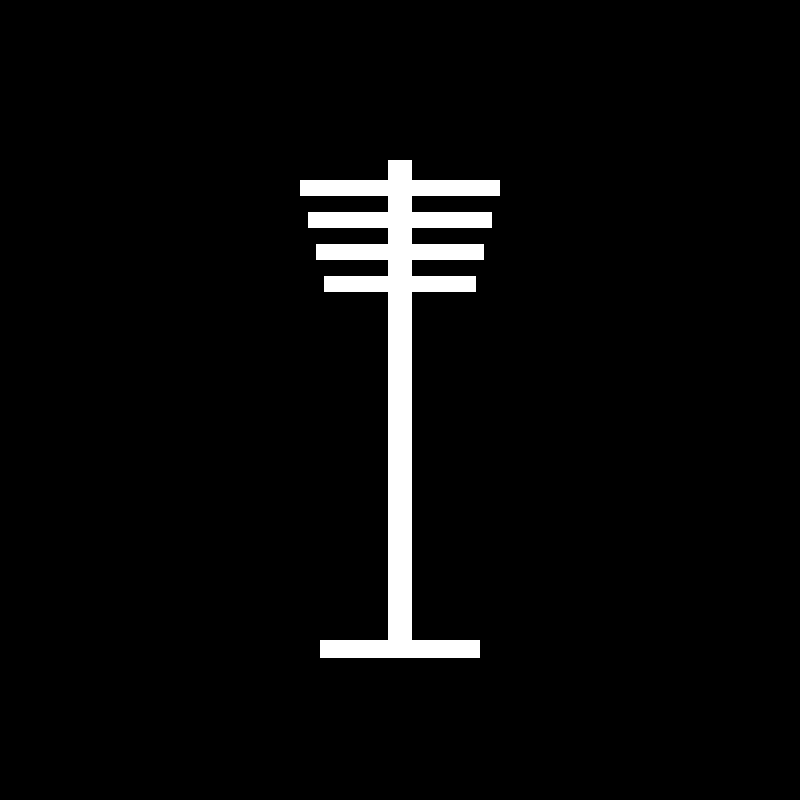
Panel 1 — Djed
The Egyptian djed. A ritual object, carved and drawn for thousands of years before any alphabet existed, not originally a letter. The word means stability or endurance. Associated with the standing spine of Osiris, raised in ceremony at the turning of the year, carved into tombs and household objects alike. A vertical shaft with horizontal crossbars at the top. The Egyptians drew it often. It meant something that stood up and kept standing.
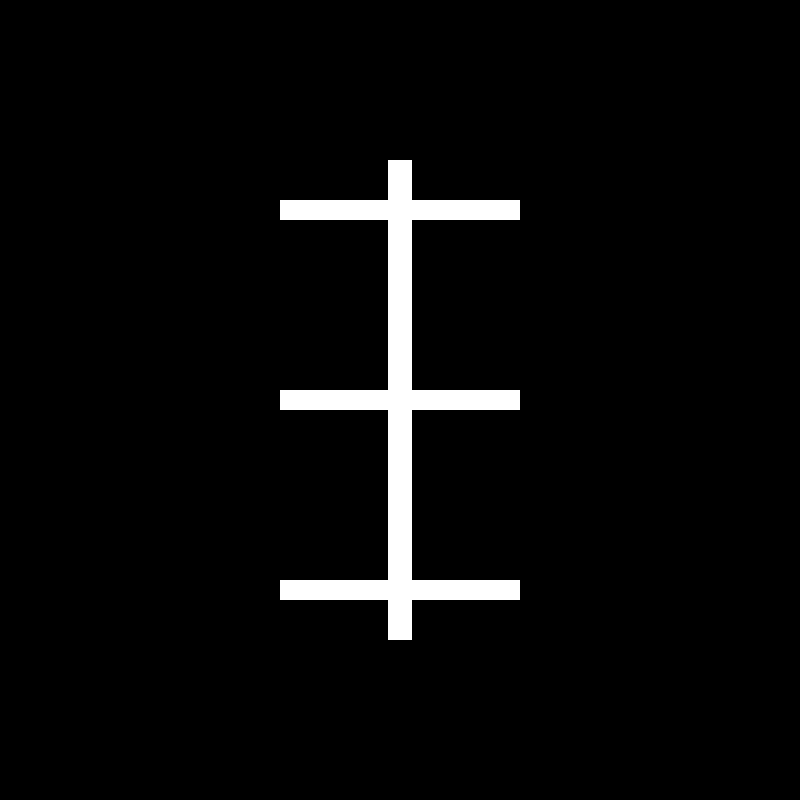
Panel 2 — Samekh
The Phoenician letter Samekh (SAH-mek) in use around 1000 BCE. The name translates as support or prop. The Phoenician alphabet was developed by Semitic-speaking traders and workers around the eastern Mediterranean, and most of its letter names refer to physical objects — a house, a hand, an eye, a mouth, a tooth, a fish. Samekh was the support, the thing that holds something up. The shape carries a vertical with horizontal crossbars. Whether the letter descends directly from the djed is debated by paleographers; the structural resemblance is there, the documentary chain is not fully traced.
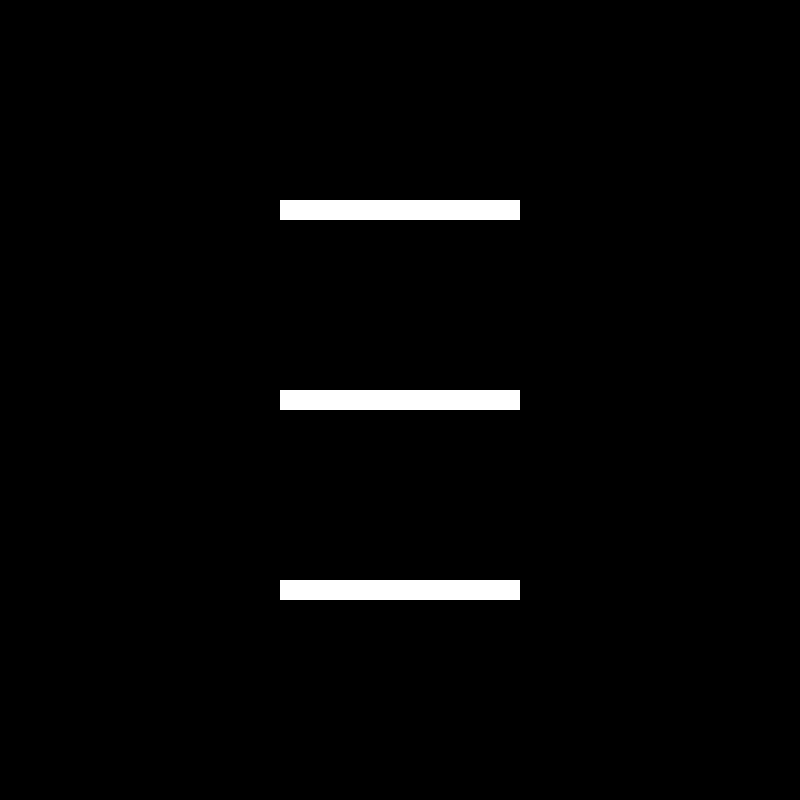
The Greeks adopted the whole Phoenician alphabet in one move. The letter-names came with it as sound-shapes with no Greek meaning. Aleph became alpha. Beth, beta. Samekh, xi. None of the names meant anything in Greek anymore.
Panel 3 — Xi
The Greek letter Xi (ksee). The Greeks adapted the Phoenician alphabet around the eighth century BCE. They kept the crossbars. The vertical did not carry across. The sound shifted from /s/ to /ks/. By the time the Greek alphabet stabilized, the letter was three horizontal lines. Support had fallen out of it. Xi was a letter that made a sound.
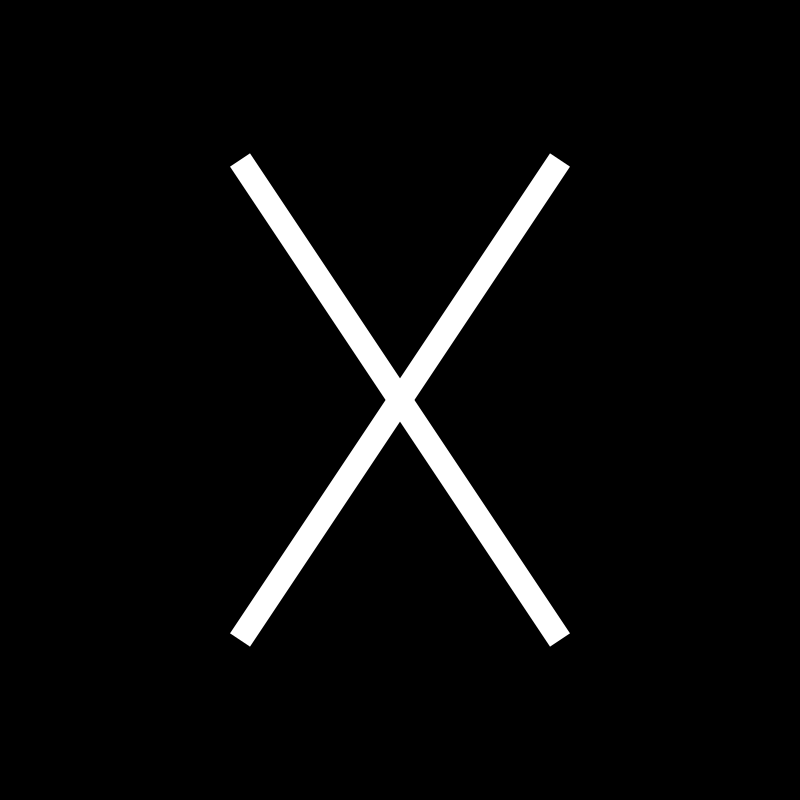
Panel 4 — X
The Latin X. A different route. The Romans adapted their alphabet from a Western Greek source, and Xi had fallen out of use in those variants. What the Romans took was Chi — two crossed diagonals — used for the sound Xi had carried in the Eastern Greek world. Two lines crossing at a single point remain. The name support does not survive. The pillar does not survive. The crossbars do not survive. What remains is the sound the letter carries, and the mark two strokes make when they meet.
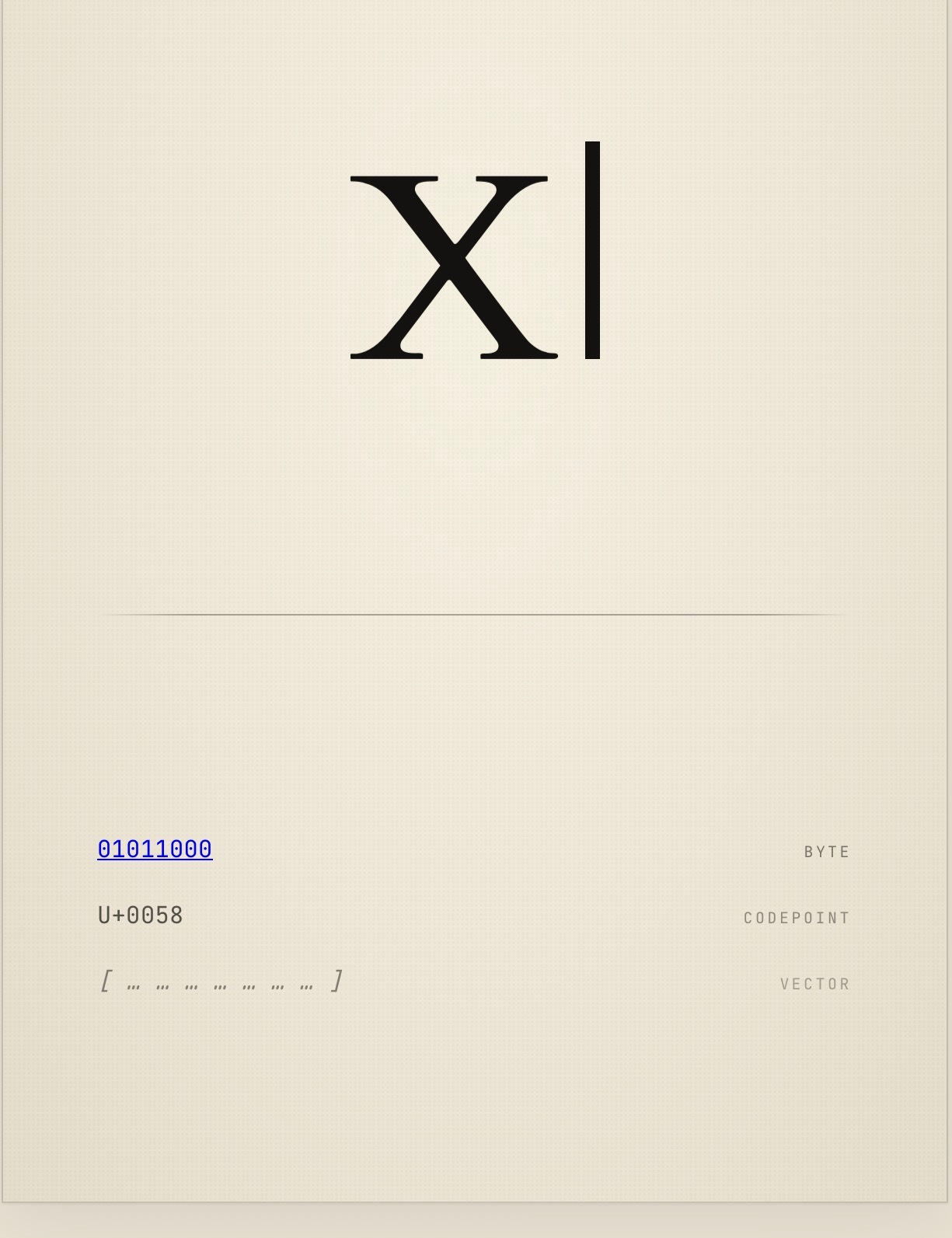
Panel 5 — The typed X
The typed X. Shape identical to the Latin X. A keypress summons a stored template. The hand is gone. The stroke is gone. The glyph looks unchanged.
Beneath the surface: the byte, 01011000 — a pattern of on and off. Beneath the byte: the codepoint, U+0058 — a position in a table. Beneath the codepoint, in the language models reading and writing now: a vector in a space of relationships. No shape. No name.
The surface preserved. Everything beneath, replaced. The eye catches none of it, because nothing in the shape tells you anything was lost.
The surface between maker and reader. Once: a hand, a tool, a body. Now: we cannot tell what is on the other side.
My fingers punch a pixelated keyboard. Uniform letters appear. They rearrange when I misspell — sometimes to the word I meant, sometimes to the wrong ones. Sometimes I type the half-finished sentence into an AI and ask it to polish the end. Words appear in response. Coherent. Fluid. Grammatically perfect. Words birthing words through calculation — the only body they touch in their making? None.
If the piece landed, pass it to someone it might land for.
Like it, subscribe, stay close to what comes next.
If you want to keep the work fed, buy me a coffee: http://buymeacoffee.com/anthonyn19c