
Machine minds: $100 million each. Human minds: $0 on the books. Guess which we’re running out of.
The Invoice

A companion to “The Cost of Intelligence.”
Bait
Yes, that headline is bait. It is also, line by line, true, which is the problem this article is about. I ran the sincere version first, and the market priced it the way it prices all care: at zero. So the toll is paid,arousal before assent, the only currency the feed accepts and the mechanism that just fired in you is the subject of everything below. Even the true title had to travel under the loud one; it’s the small line, “The Invoice”. Now, the books.
The Value of a Country
A century ago the economists wrote it down. Pigou: if a man marries his housekeeper, national income falls. Same rooms, same work, same hours, the wage entry deleted at the altar. The UN then drew the line formally. The System of National Accounts places services a household produces for itself outside GDP by definition. Two mothers paid to raise each other’s children expand national output; each raising her own registers nothing.
The boundary keeps one exception: own the house you live in and the ledger makes you your own landlord, invents the rent you would pay yourself, and counts that invented payment as output. The single household service inside GDP is the one that flows from a thing somebody holds title to. Cooking, cleaning, raising, real work, no deed= zero. Shelter from an owned house (an invented price), booked in full. The test is title. Marilyn Waring audited that boundary in 1988, and it stands today. The zero on care is a drafted clause, dated and still in force. Hold the exception; it names the rule.
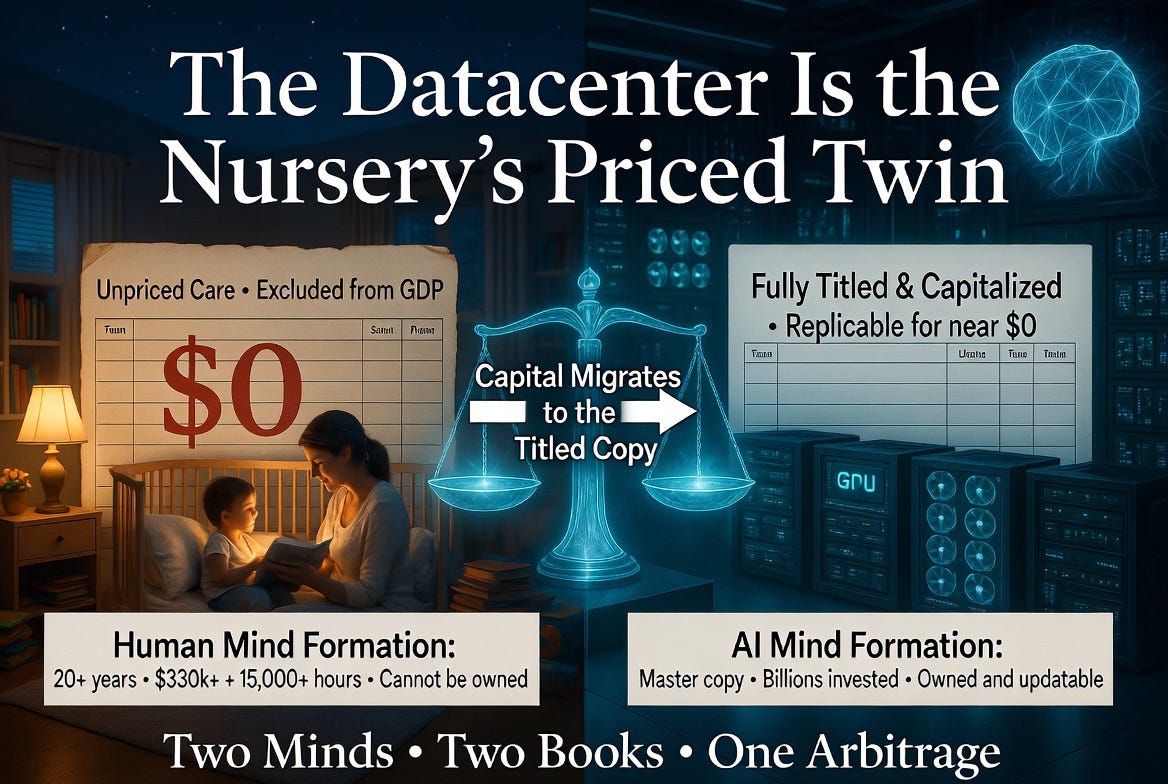
An offer you cannot refuse is not an offer
The mechanism under the clause: a price is a quote to a seller who can refuse, and for most of recorded history the seller of care could not. The law barred a wife from most paid work and from keeping her own wages, and coverture went further: it made her labor his property. The common law meant it. If a stranger injured her, the husband sued for damage to his asset, the same claim a master brought over a hurt servant. Care sat on a ledger once, as his. Then the Married Women’s Property Acts dissolved that title, statute by statute through the 1800s, and nobody wrote a price where the title had been. A ledger holds one entry for what nobody can own: zero. While the work was forced, its supply had looked like nature’s plenty. When the force lifted, one word did the rest: she was freed, and her labor was booked as free. The zero was enforced first and mistaken for physics afterward. Care got booked like air: essential, everywhere, assumed infinite.
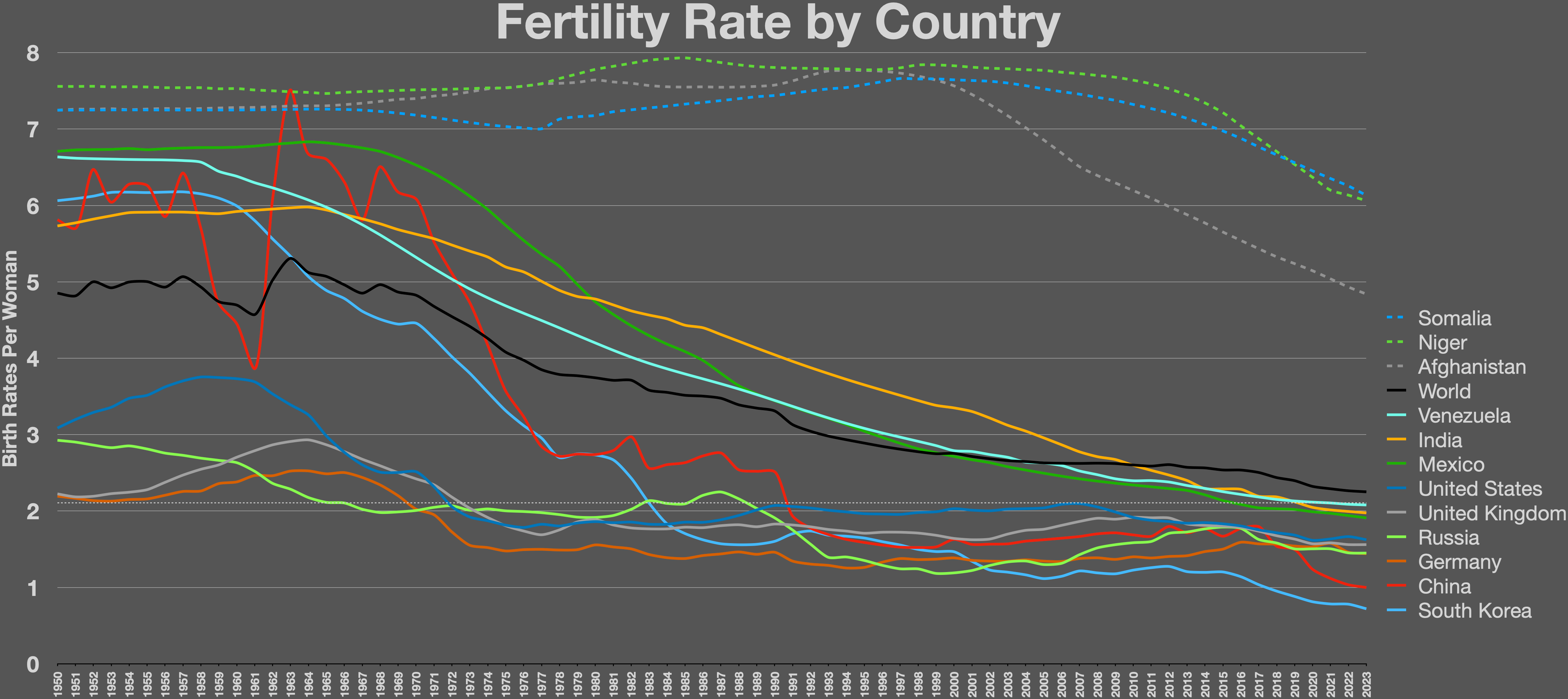
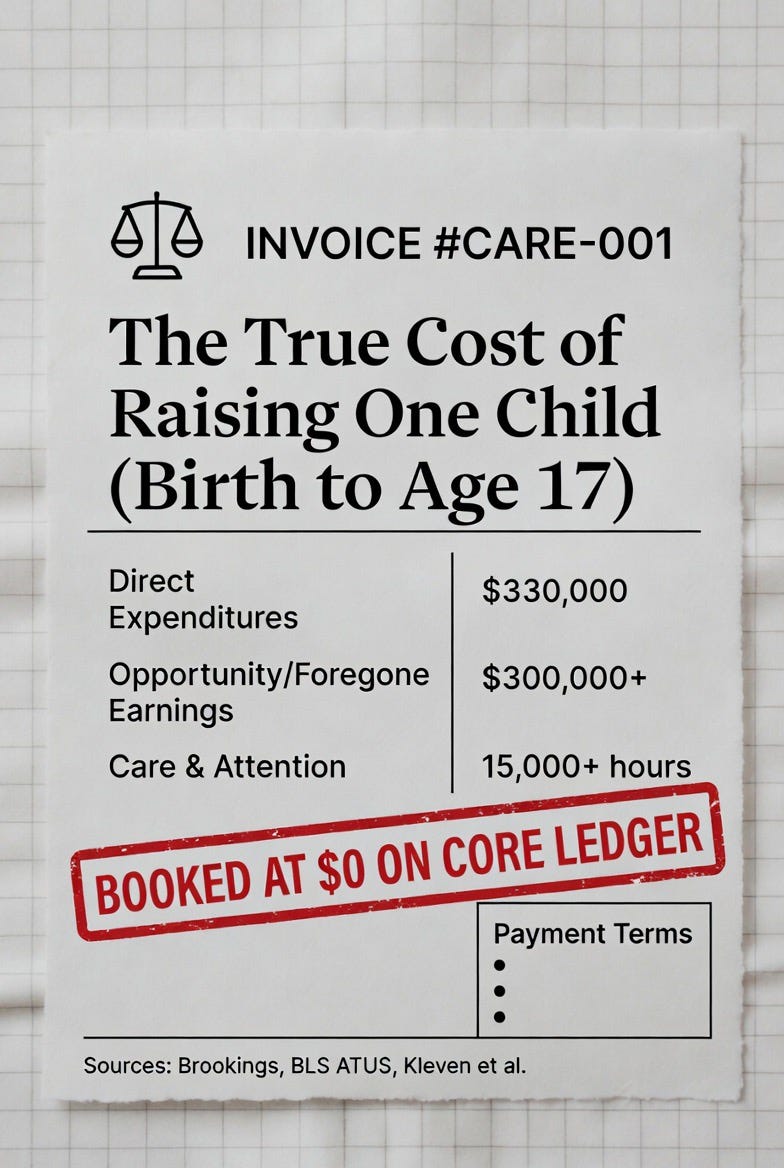
The supply curve is now speaking for the first time. Refusal became affordable through contraception, wages, other options to exit and the quantity supplied at a price of zero is collapsing. Korea around 0.75 births per woman. Italy and Japan near 1.2. China near 1.0. The United States about 1.6, against a replacement rate of 2.1. The pronatalist failures are price discovery: a market learning, bid by failed bid, what the good actually costs. Hungary’s own government prices its family policy at about 5% of GDP; Korea has spent roughly $270 billion across two decades and bought back a few hundredths of a birth. Every failed subsidy marks a floor under the true price. Raising one American child runs roughly $300,000 in direct cost before counting foregone earnings that can exceed it, and states are bidding a few thousand. The good finally has a bid, and the bid-ask spread, the distance between what buyers offer and what sellers require, measures a century of extraction the cost structure assumed was free.
The Price of Air
Air confirms the model from the other side. Its zero held exactly as long as abundance did; the moment depletion registered, sulfur in 1990, carbon after, the price appeared. So the two great zeros are failing in the same window. Carbon markets and fertility collapse are one event posted to two ledgers: the audits arriving on the two inputs the whole engine booked as infinite.
The Cost of Forming a Mind
The essay this note rides alongside argues the sharpest instance. The AI training run puts mind-formation on a balance sheet; capex, a depreciation schedule, an investor call, and honesty requires the precedent: this has happened once before, in the ugliest books American capitalism ever kept.
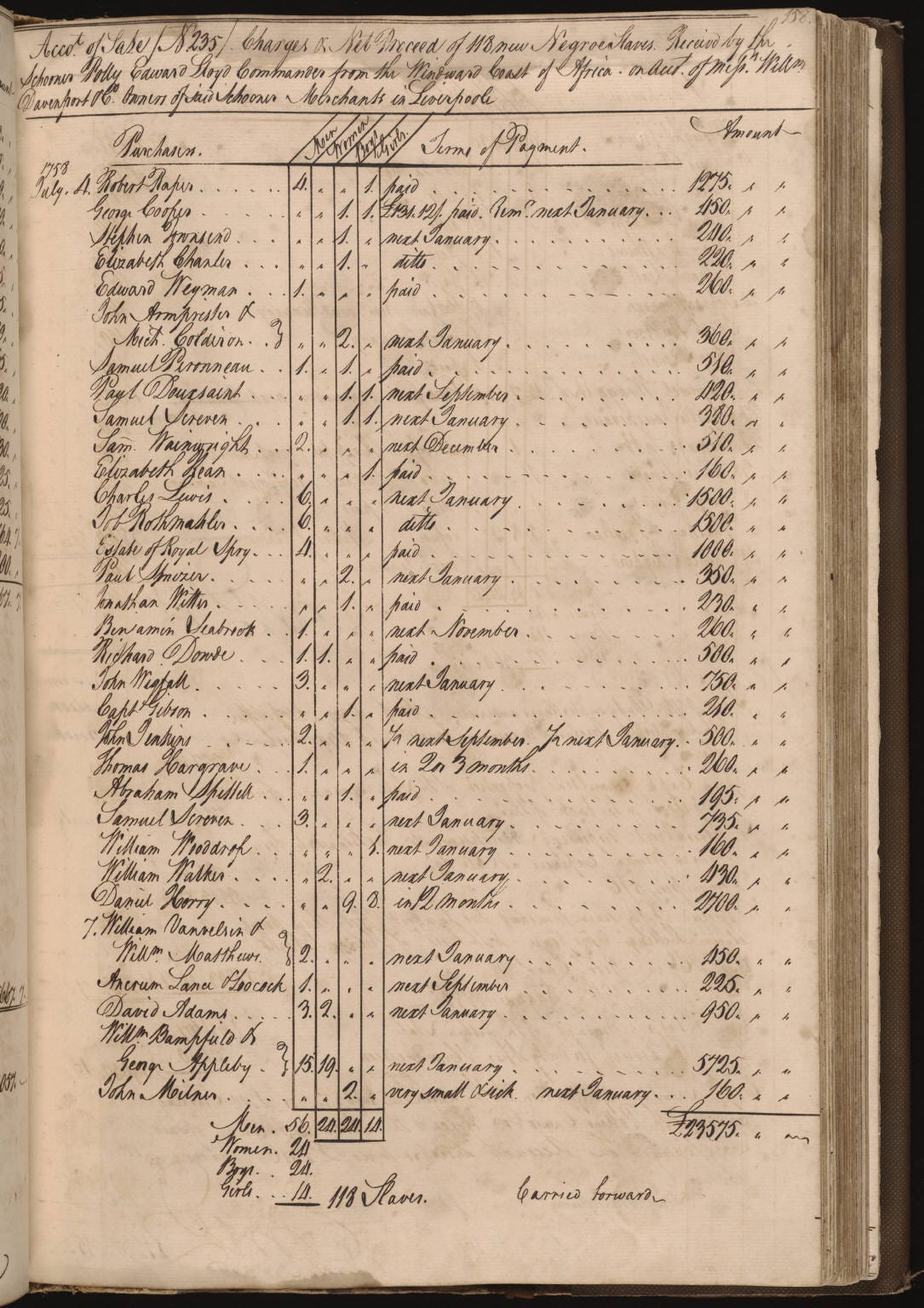
Plantation ledgers carried human beings as assets and children as appreciating ones, complete with valuation schedules; Caitlin Rosenthal read those books and found precursors of modern management inside them. The precedent sharpens the rule: formation reaches a balance sheet exactly when law permits title over the mind being formed.
Arbitrage
The datacenter is the nursery’s priced twin, and its existence exposes the forgery retroactively, because we now know what building a mind costs when someone has to pay. The books found a bridge until the owned copy is ready, migration—an arbitrage: the same good carries two prices on two books, and whoever moves it from the cheap book to the other one keeps the gap. A surgeon takes an average of twenty-five years to make. Import them, and every hour of the making stays on their home country’s ledger, booked at zero; the receiving economy collects a finished mind and pays wages only, from arrival forward.
Twenty-five years of formation, acquired for nothing, kept off every record. Except the economists did write it down, half a century ago. The brain-drain literature priced what sending countries lose, and Bhagwati proposed a tax to bill it. That invoice was drafted in 1973. It has waited uncollected since Even family court, the one institution built to price child-rearing, prices only the transfer of dollars between households; the labor and care for the children crosses that ledger at zero too.
Objection!
Now the strongest objections. The demographers say the collapse is multi-causal. Cohort-level “shifting priorities,” in Kearney and Levine’s phrase: later partnering, intensive-parenting norms, greedy jobs that pay a premium for always-on availability, the reordering of adult life away from parenthood as default, and that no single policy or cost variable explains the slide. Grant this in full. A price is whatever must be surrendered, and the bid for a child is now denominated in career trajectory, identity, partnership search, and hours already sold to the feed. A norm is where a society posts the prices it declines to write down. “Parenthood stopped being the default script” is this note’s mechanism in the sociologists’ dialect: the conscription lapsed, and supply at a price of zero is doing what unconscripted supply does.
The cross-country evidence runs the same direction. Among rich countries the old negative relation between women’s employment and fertility weakened decades ago and by most readings reversed: births now run highest where career and family are most compatible, meaning usable leave, cooperative fathers, flexible work, which is a price gradient standing in the open. Societies that absorb more of the true cost get more of the good; Korea, maximal incompatibility plus a private education arms race, holds the floor. The hard case is the Nordics: the best-funded compatibility infrastructure on earth, and Finland’s births still fell by a third after 2010, first births fastest, and fastest among those with the least. That is evidence about the currency. Cash and daycare bid in money and months while the remaining cost is charged in hours, meaning, partnership, attention — and in Helsinki, Anna Rotkirch, who directs the Population Research Institute and has served as Finland’s governmental rapporteur on demography, says the quiet part: childbearing runs on face-to-face couple time, her surveys tie postponement to hours on social media, and the screens hold those hours now. The hope that machines will hand the hours back has run before; Ruth Schwartz Cowan traced how each appliance wave raised the standards of care as fast as it saved the labor, and freed hours flow to the highest bidder, which for two decades has been the job and the feed.
Calibration
Timing, honestly: the world still adds people; the UN projects a peak near 10.3 billion in the 2080s — while 63 countries, China among them, are already past theirs. The scarcity arrives ledger by ledger, richest first. The economists say AI is the adaptive response, and Acemoglu and Restrepo showed the fastest-aging economies adopt machines fastest, which concedes the diagnosis: substitute capacity gets built for inputs running short, and capital is fleeing the unpriced input for the priceable one. The optimists add that fewer people with more capital each can mean rising average living standards, and some demographers hold that an educated, smaller population does fine below replacement. Both may verify as substitution, the titled copy swapped in for the unpriced original, with ownership concentrated in a handful of registries. And the price structure sets the trade’s direction, at the one point the headline blurred: nine figures buy a master copy, and every instance after runs nearly free, while the human original costs the full twenty years per mind, every time, with no copies. Capital migrates from the input that costs everything per unit toward the one that replicates for nothing; the direction was never in doubt.
Read the gap carefully: what the money is buying is a mind that can be owned. And the accountants’ defense, that the value of care is already measured; Britain’s statistical office prices unpaid household work at 3/5th the size of GDP, and every country that counts finds trillions, completes the indictment. Calculated, filed in an annex, kept off the core books that budgets follow. A satellite account, the formal name for that annex, is a confession stored where no allocation reads it.
What We Are Actually Talking About
And here I catch myself talking like an accountant. Don’t let the numbers hide what they are numbers of. These are living beings, children, parents, elders, families abandoned to the cost and then blamed for the deficits. This is my life. These are my children, whom I love beyond anything in this note, entered in a worksheet as arithmetic. The infrastructure everyone stands on is built on caregivers’ shoulders at a price of zero, while the raising of machines; machines that eat the planet’s power and the population’s words — is priced in the trillions.
Precision
Then be precise about the actors, precision cuts deeper than conspiracy. The firms that converted socializing into engagement, that spent two decades turning connection into inventory and fortunes into rules that favored them, are the same firms now capitalizing the substitute minds, positioned to sell the remedy for a scarcity their extraction helped deepen. The coordination is performed by the incentive gradient itself: each actor optimizing locally, the way a thousand walkers wear one path across a lawn with no surveyor among them.
A constructed mind can be updated, monitored, aligned to shareholder value, and ultimately owned. A human mind cannot. The accountants wrote that rule into doctrine themselves: under the standards, an asset is a resource the entity controls, and the standard-setters say in as many words that a firm has insufficient control over a team of skilled staff for their formation to count as one; staff can quit. Weights cannot. When one company buys another, the acquired workforce dissolves into goodwill (the accountants’ word for value they can see but cannot title) for the same reason.
Closing the Loop
Capitalization follows enclosure; a balance sheet can hold only what someone can hold title to, so the ledger zeroes every asset that resists ownership, and the zero on the biological original is what makes the arbitrage clean. Here the note’s opening closes into a loop: the national accounts price the one household service attached to a titled house; the common law priced a wife’s services while a husband held title to them; the plantation priced the person while the law allowed a person to be property. The human original was de-titled without ever being repriced, and the substitute arrives pre-titled, capitalized at full freight from its first line of capex.
Concentrated power has always preferred the substrate it can control; that preference is older than the ledger. The booking is still a choice.
Filed
The century saw it coming. Pigou dated the clause, Waring audited it, the statisticians priced it to the pound and filed the sum in the annex. An economy keeps one working eye and one alarm. The eye is the core ledger; the alarm is a moving price. Care had neither an entry nor a price, so the depletion ran loud in the reports and silent on the books, under record output — and every alarm that did ring was silenced the same way: filed.
The cost landed first where it always lands, in the caregiver’s spent hours, in the elder’s unvisited room, and stayed off the books. The fertility data is the same loss written at last in numbers the core books must read: workers, pensions, growth. It has been read. The response is clear. Faced with the first invoice care ever sent, capital is answering with the one thing it can title: a copy, a seller who cannot refuse. The copy pays nothing on this bill; it defers it.
A deferred audit, at interest, because absence compounds: every child not born is a parent the next generation won’t have. And it arrives with no bailout counterparty. Every rescue so far had someone standing on the other side of the trade to receive the capital, a bank, a firm. Here the other side is empty. The failing asset is the people who were never born, and you cannot recapitalize the missing.
The Invoice
An invoice that names an amount without terms is only a complaint, so here are the terms — three, one for each book.
For the budget: enter the confession into the record. The trillions are already calculated and sitting in the annex; move the sum to the core books that budgets follow. Set it in front of the working eye, because a budget can defend only what it sees.
For the payroll: pay in the currency the cost is charged in. The cross-country evidence already showed that societies buying compatibility (usable leave, cooperative fathers, hours that flex around a child) get more of the good. That gradient is an instruction filed as a finding. Unfile it.
And for the household — meaning you, tonight: bring the hours home. The screens hold the couple time and the floor time formation runs on, and attention is the one coin every reader already holds. An hour taken back from the feed is a remittance no budget season can lapse. All three pay in the denominations the bill was written in — visibility, structure, time. The graveyard of failed subsidies cannot refute them: every stone in it marks a bid of cash at a bill charged in hours. And the rule this note keeps meeting predicts the friction: a system pays most readily for what it can title, and care resists title. So the terms skip the system and name the keepers of its books; a legislator’s hand can move a line, an employer’s can write a policy, yours can shut a screen.
A budget line.
A leave policy.
An evening.
Sources (working citations)
1. Pigou — A. C. Pigou, The Economics of Welfare (1920; 4th ed. 1932): the housekeepermarriage passage on the national dividend.
2. Production boundary — UN et al., System of National Accounts 2008: own-use household services excluded from GDP; imputed rents of owner-occupied dwellings included. Marilyn Waring, If Women Counted (1988).
3. Coverture as title — Blackstone, Commentaries on the Laws of England, Book I, ch. 15 (“Of Husband and Wife”); common-law husband’s actions for loss of a wife’s services and consortium. The ledger framing is the author’s extension [T2].
4. Fertility rates — Statistics Korea: TFR 0.72 (2023), 0.75 (2024), modest rebound reported since; ISTAT (Italy ≈1.2); Japan MHLW (≈1.15–1.2); China ≈1.0 (UN WPP 2024 estimate); US NCHS: 1.62 (2023). Replacement: 2.1.
5. Hungary — the government’s own figure: ~5% of GDP on family support (Deputy State Secretary for Family Affairs, 2023: 5.5% for 2022; Foreign Minister Szijjártó, June 2025: 5% target). Independent tallies vary with the programs counted (AEI, Nov 2025); Eurostat’s narrower family/child category: 2.6% of GDP (2022).
6. Korea spending — ≈360–380 trillion won (≈$270bn) on birth-rate policy since 2006; government figures via Reuters, Al Jazeera (Mar 2025), CBC (Jun 2026).
7. US child cost — Brookings (2022): ≈$310,000 direct cost, middle-income family, child born 2015, through age 17 (inflation-adjusted from USDA). Foregone earnings: childpenalty literature (Kleven, Landais & Søgaard and successors).
8. Air’s repricing — Clean Air Act Amendments of 1990, Title IV SO₂ allowance trading; EU ETS (2005–) for carbon.
9. Multi-causal objection — Kearney, Levine & Pardue, “The Puzzle of Falling US Birth
Rates since the Great Recession,” Journal of Economic Perspectives 36(1), 2022 (“shifting priorities”).
10. Employment–fertility reversal — Ahn & Mira (2002), Journal of Population Economics; Doepke, Hannusch, Kindermann & Tertilt, “The Economics of Fertility: A New Era” (2023).
11. Finland — Statistics Finland: TFR 1.87 (2010) → ≈1.26 (2019), ≈1.25–1.3 since; first births leading the decline, steepest among the less-educated: Hellstrand, Nisén & Myrskylä, Population Studies (2020) and subsequent register-based work.
12. Rotkirch — Anna Rotkirch, Research Professor and Director, Population Research Institute (Väestöliitto), Helsinki; Finland’s Governmental Rapporteur on Demography. Family Barometer surveys linking postponed childbearing to social-media use; review work on ICT displacing face-to-face family intimacy; her stated claim that screen use erodes couple time and, through it, childbearing decisions (coverage, Apr 2025).
13. Appliances — Ruth Schwartz Cowan, More Work for Mother (1983).
14. Population peak — UN World Population Prospects 2024: peak ≈10.3 billion in the 2080s; population already peaked in 63 countries and areas.
15. Aging and automation — Acemoglu & Restrepo, “Demographics and Automation,” Review of Economic Studies 89(1), 2022.
16. Smaller-but-educated case — Wolfgang Lutz and the Wittgenstein Centre’s educationweighted demography.
17. Satellite accounts — UK ONS Household Satellite Account: unpaid household work valued at £1.24tn (2016), ≈63% of GDP; comparable exercises in every country that runs one.
18. Plantation ledgers — Caitlin Rosenthal, Accounting for Slavery: Masters and Management (Harvard University Press, 2018).
19. Migration — the brain-drain economics of the 1960s–70s put the sending country’s formation costs on the books (Grubel & Scott, American Economic Review, 1966, onward); Jagdish Bhagwati proposed taxing skilled emigration for exactly this transfer (Bhagwati & Dellalfar, World Development, 1973).
20. Control criterion — IAS 38, Intangible Assets: recognition requires a resource controlled by the entity; insufficient control over skilled staff and training (¶15). IFRS 3 / ASC 805:
an assembled workforce is subsumed into goodwill, unrecognized as a separate intangible.
21. Author’s syntheses [T2/T3, per the essay’s convention] — conscription read back as abundance; carbon and fertility as one audit on two ledgers; family court pricing the transfer only; capitalization follows enclosure.
22. Machine-side figures (capex, master-copy economics, data exhaustion) — sourced in the companion essay’s citation block.