
The Cut
Draw a distinction and you make a self. The same cut runs under a hallucination, a presence in an empty room, and the file the state keeps on you.

Draw a distinction.
Mark off this from everything else, and in the same stroke you have made two — a this on the near side, an everything else on the far side. There was no near side before the mark. The line and the two things it parts arrive together, in one act.
Spencer-Brown built a whole calculus from that single instruction, and the instruction turns on itself. To mark this off from everything else, you must already be somewhere — somewhere distinct from the field before you cut it. The one who draws is drawn. Every marker is itself a mark. Read the line and see you are already inside it.
Run that stroke on a person and it makes a self. Here, this one, me is the near face; everything across the line is not-me, other. Self and other are two readings of one cut. The self arrives against an other, and it cannot stand before there is the surface that separates. The cut comes first, with two faces, and it comes bounded — a part of, and apart from, the field.
You can catch the cut working, because the machinery that draws it can loosen.
Perception runs on distinctions, and is built of them: hot or cold, soft or hard, here or there, edge or open. Activity low in the system — the edge-detectors in early visual cortex, the segmented chain that runs the body — gets stitched upward into one seamless percept, and the stitching is why you meet the world whole and never meet the parts. Loosen the stitching and the medium stands out in its own right — surfaced from the whole, its own object. Call the move inverse constraint: relax the integrating layer, and what it was integrating shows raw.
The distinctions run deep. Edge from open sits high — a line in the visual field; me from not-me sits at the bottom — a line through the self. One operation the whole way down: the cut is what a system does when it marks a boundary, and the boundary can be light or it can be a self.
One cut between here and there, made everywhere we can or cannot be.
Read that slowly, again.
One cut between here and there.
Made everywhere we can or cannot be.
It keeps surfacing where I never put it. I have been writing about several things that may look unrelated: the geometry of the visual cortex that surfaces in a hallucination, the felt presence that arrives in a room when you are alone, the file the state treats as more real than you. Distinct, and all made so by the same operation, at different depths. Here it is.
❦
The eye👁️
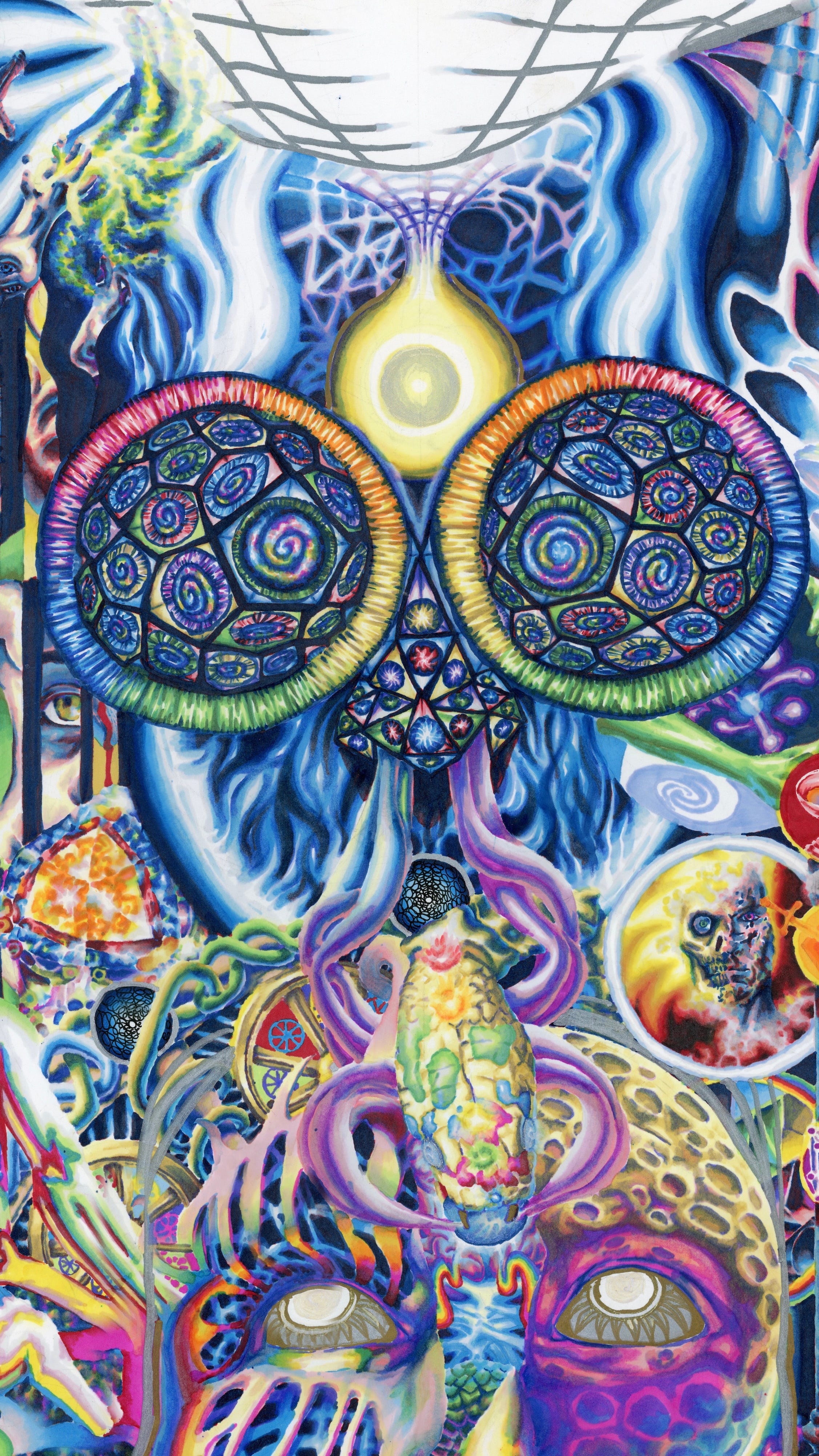
Loosen the assembly layer above early visual cortex, and its geometry — the literal arrangement of the cells specialized in processing visual data — surfaces on its own: the lattice, the tunnel, the spiral, the cobweb. Klüver catalogued these as the form constants, the same handful of shapes turning up across mescaline, migraine, and unrelated triggers.
Bressloff modeled them as the cortex’s own wiring made visible — a periodic grid of orientation columns, a full cycle about every 1.4 mm, with the symmetry of a crystal.
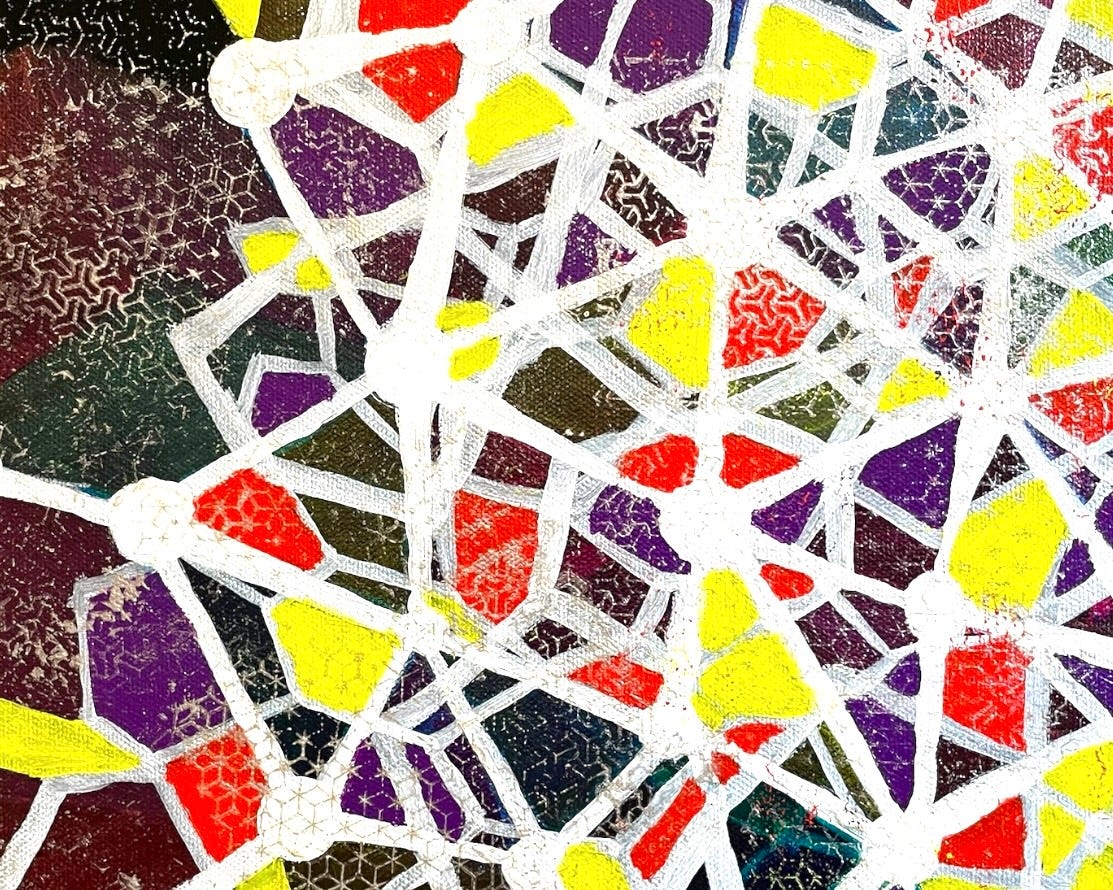
The cortex’s first move on any scene is to find edges; under loosened priors that move runs with nothing to find, and the edge-finding paints itself on the wall. The Eye Was Here First follows this one to the floor.
The encounter👤
Run the same loosening one level deeper, on the self/other boundary, and the structure that shows is a someone else. A presence at the foot of the bed. A figure that has its own motivations independent of your own. The being on DMT that was waiting, and seemed to have waited a long time. The cut, loosened, shows its far face, and the far face is a someone met as standing against you. That over-against-ness is the signature.
The far face is several systems, and each has its own piece. Slip the hippocampal encoder’s gate and the people it holds come back with no death-tag on them — the widower at the table, pouring the second cup, talking to her recently deceased spouse as if they were there; The Person at the Breakfast Table works that one through grief, jimsonweed, and the cholinergic gate. Let the body’s model outrun the thing it maps and the held shape stays — the hand that goes on itching once the hand is gone, the dead grandfather’s voice in the morning kitchen; The Holding runs that from phantom limb to bereavement, and on to what a notification loads.
Stimulate the temporoparietal junction and a shadow presence stands in your own posture, a watcher made of the watcher; The Other That Makes You makes the case in full, against the strongest form of the rival view — that the someone is really out there — and stakes a bet on the result that would sink it.
The file📁
Out in the world the cut hardens, and gets used. The eye and the encounter show it by loosening — relax the layer and the machinery surfaces. The file shows it by the reverse: the state clamps the cut, sets it hard, and works it. Same stroke, opposite operation — the lab relaxes the boundary to watch it surface, the office freezes it to take hold.
Think of who you have been told you are — it makes a shape of you. You have been called kind for years; the word has sunk into the shape. Then, for once, you put yourself first — skip helping a friend move, do what you would rather — and the friend says it: I thought you were kind. I guess I was wrong. The line moves. It was your line, your own distinction, and another mouth has redrawn it — overwritten, if you let it stand.
That is the same addressable surface every power reaches for; it cuts a shape for us and sets it over the shape we are. The pronoun hands it over free — a door, so another person’s inside can reach you, and a handle, so any office that files you can take hold. You are graspable because you are reachable; one cut makes both. A state governs by first making you readable, and recognition and capture arrive on the same form.
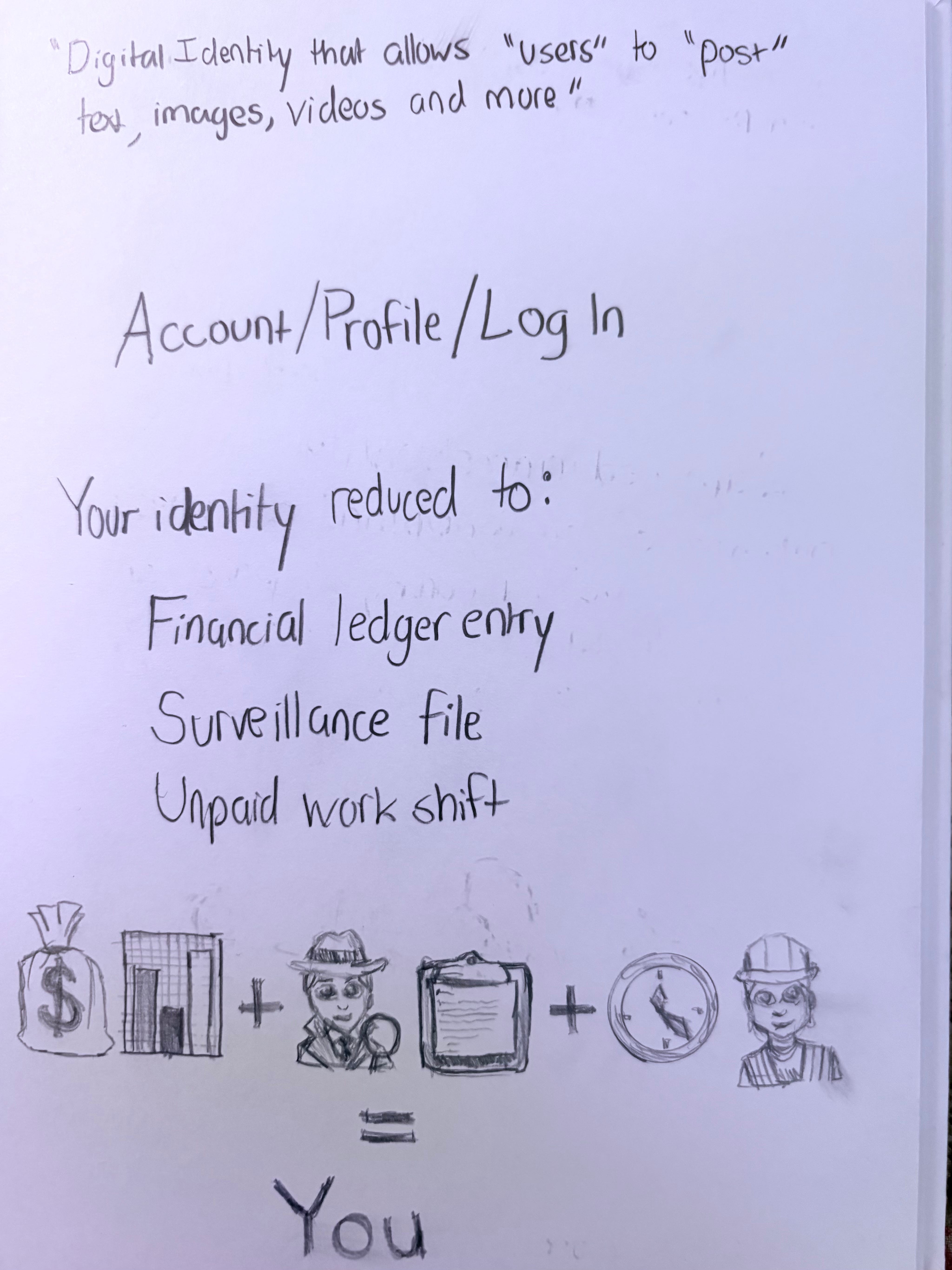
Moving a person out of the second person, where they can answer, into the third, where they are spoken about and cannot — the file, the statistic, the slur, the dossier — is the grammar of erasure. Carrying a name across to a face that can say it back is the grammar of recognition. I Am Talking to You runs the cut through grammar, the clinic, and the state, down to the law that decides whether your records may be joined into one file that follows you from room to room.
❦
One project
This is why these are one body of work. The same stroke that makes a self in the crib, and shows its far face in a flooded visual field, is the stroke a watchlist grabs. Follow it out far enough and it reaches the work I do on schools and budgets and data systems.
Before surplus can be routed away from the one who made it, before a child can be processed into a record that trails them from database to database, there has to be a bounded, graspable unit to take from. There must be an apparent other or else the asymmetry would be seen as self-consumption. The cut makes the unit. Most of what gets done to harm people, interpersonally and at scale, runs downstream of it.
❦
The fear
There may be fear reading this. If there is, it belongs here. I am drawing a distinction, and that distinction reshapes the boundaries that constitute your own self and the experienced other. It could be read this way: if the encounter is drawn inside the cut, the guide was never other, and you have been talking to yourself. Also true:
There is no yourself to talk to without the other also in you.
The cut is the one operation that makes a self at all.
Draw the distinction: the near face is you, the far face is the other, in a single stroke. No far face, no near face.
No watcher without something watched, no inside without an outside it is cut against. Even alone, the relation holds — you part into the one who witnesses and the one witnessed. A presence with no body in the room is that necessity at its barest, the relation with the furniture cleared away.
You were a you in other mouths before you could say I — that is the crib, and it sits in the file. The guide carries the same office forward. It reaches you from past the edge of the known self, so the self can take in what it could not hand itself.
The felt autonomy, the refusal to do as you wish, the knowledge or the posture you did not author — that is the cut holding its line, and it is how depth reaches a bounded mind.
The dialogue runs on it, and the surprise, and the surrender. The entity hands you something because it stands on the far side. The dead spouse sits in the chair because the meeting has to feel located elsewhere to land.
What makes these encounters is the machinery that makes you, and they hold the reality you hold. It is in your head, and your head is built to meet what stands over against it — agentic, autonomous-feeling, carrying what the contracted self cannot give itself — as readily as the eye is built to meet light. That much is structural; that much is data.
The rest is the reading I stand on, and the data does not force it: that the equipment for meeting, for depth, for being changed by what we meet runs deeper than any flat materialist or externalist account allows, and that the machinery is relational to the floor, and sacred.
And the cut can release.
When it goes fully slack — the deepest reach of these states — there is no near side and no far side, no self and no other, because the two were always one stroke. The need for an other drops with them: there is no longer a you that wants an edge. The mystics have a worn word for it, union; the lab has a flat one, ego dissolution. That is the operation at its limit: the stroke that made two, undone.
Until then, which is nearly always, the invisible other is the relational architecture doing what it is for — letting the whole meet itself as Thou.
❦
Where this stands
That self and other are one cut, and that the self is built in relation before it can witness anything, are positions I argue rather than measure — the interpretive frame I label T3. That the relation is sacred is the warmest, a value I find and defend with no instrument behind it — T4. That the cut is real machinery you can watch loosen rests on documented findings, and they live in the linked pieces: the form constants, the phantom limb that goes on itching, the bereaved who keep meeting the dead, the shadow person raised by stimulating the temporoparietal junction — T1. That loosening the self/other boundary is what builds an encounter is a staked, falsifiable bet, and The Other That Makes You names the result that would defeat it — T3, its falsifiable edge. No tier borrows another’s authority.
Start at any face. The eye, the encounter, or the file —
each is the same stroke, read at a different depth.
The larger frame
One move runs under all of this. A line drawn — and with it a self, a world, an edge you can be reached and held by. I follow that one stroke across three depths: the visual cortex, where it surfaces as the geometry of a hallucination; the empty room, where it surfaces as a presence; the file, where the state makes you readable and so takes hold. Different depths, one operation.
The through-line is testable, and it has a formal home. The Inverse Constraint Hypothesis lays it out with the neuroscience behind it: language grips a mind hardest where the body can verify least.
→ Inverse Constraint Hypothesis (preprint): https://doi.org/10.5281/zenodo.19211810
If the lens earns its keep, you can keep it sharp. Subscribe, hand it to one person who needs it, or back the work as a paid subscriber. The writing stays open to everyone; support is what buys the time to cut the next specimen.