
The Eye Was There First
How a laser, a wall, and pharmacology revealed the eye to its own sight

We have invented many tools that allow us to see what has always been there but otherwise invisible to us. A microscope reveals entire worlds — fully formed negative crystals inside a gemstone, living ecosystems in a drop of water — we never would have witnessed with our eyes unaided. A prism reveals the spectral colors hiding in what previously appeared as white or colorless light. Both tools work the same way: they transform light before it enters the eye, allowing for greater resolution or partitioning of components.

What follows is about a third such instrument — except this one is made of photons and pharmacology, and the components it reveals are the building blocks of sight itself.
DMT (dimethyltryptamine) is a psychedelic compound produced naturally in the human body in trace amounts. What it does to vision when well above tonic levels is the subject of this piece.
People on DMT, staring at a red laser projected through a grating onto a wall, report seeing geometric characters. Sharp, angular, three-dimensional. Described as resembling Japanese katakana. Move the laser to a different surface and the characters change. Shine it on skin and the “code” is different from the “code”on drywall. Put three people in the same room, all three on the same substance, all three looking at the same laser on the same wall — and all three see the same symbols.

Danny Goler’s research community has documented this across more than 3,000 participants. A pilot study published in IPI Letters (2025) formalized the protocol under controlled conditions: a collimated 650nm laser projected through a diffraction grating onto a non-reflective surface. The grating splits the beam into an interference pattern — the field of light and dark bands that forms when waves overlap, reinforcing in some places and canceling in others. The same geometry you see when two ripples cross in water. The surface texture shapes it further. Together, they give a rich, organized visual field to process — and the substance strips away everything that would normally interpret the result.
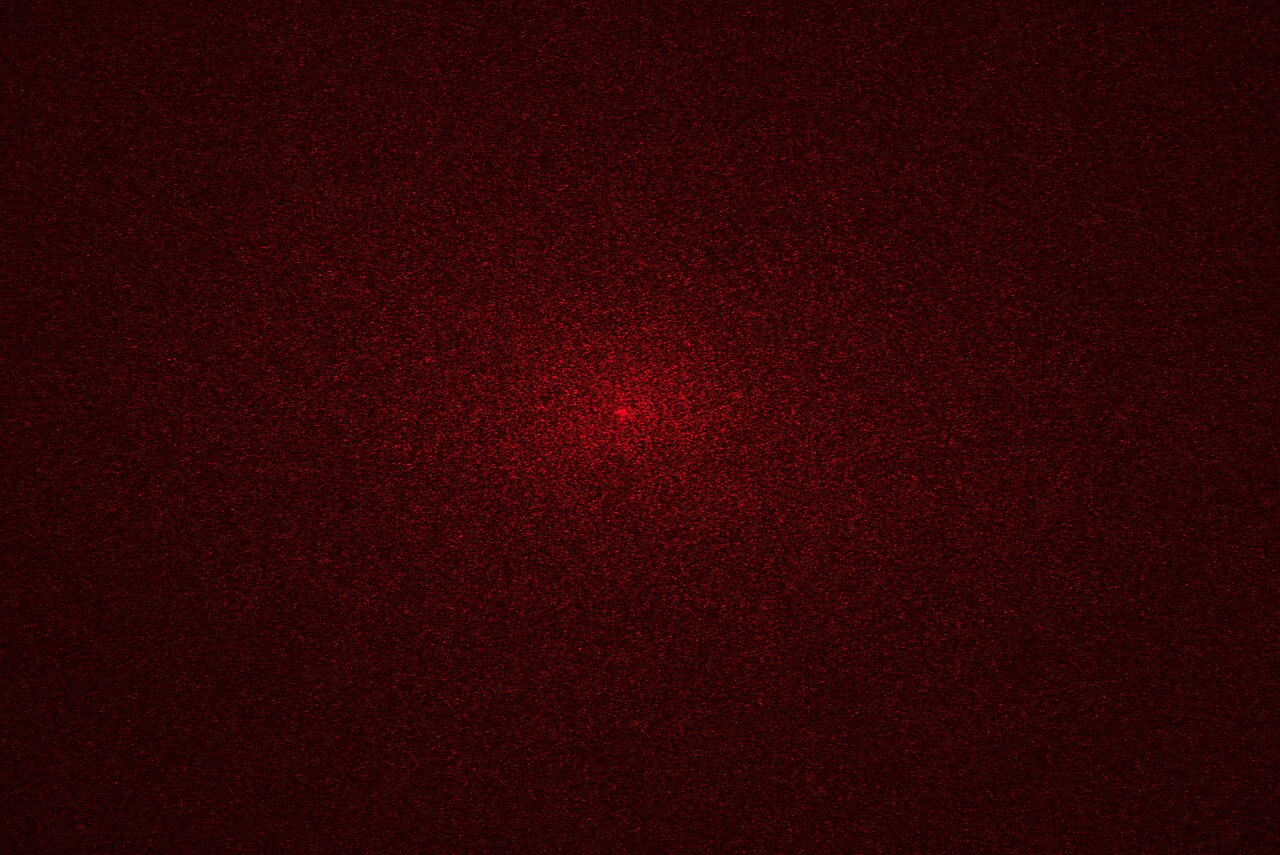
The consistency is the finding. Random hallucinations don’t synchronize across observers.
Your primary visual cortex — a region called V1 — has a job that runs before anything else in vision. Before you recognize a face, before you identify an object, before you know what you’re looking at, V1 detects edges. More specifically, it detects the places where edges meet.
There are three types of edge-meeting. Only three.
An L-junction: two contours meeting at a corner. The edge of a table against a wall. A T-junction: one contour stopping against another. A pencil lying across a book, its edge disappearing behind the book’s edge. An X-junction: two contours crossing. Rare in ordinary scenes — most objects are opaque.
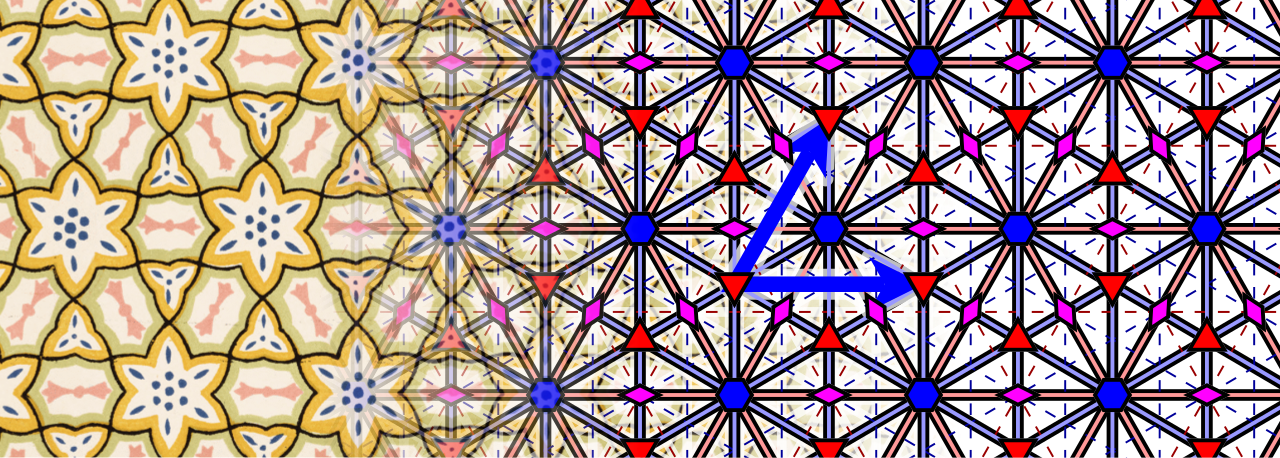
L, T, and X. That’s V1’s entire vocabulary at the junction level. These are detected in the first milliseconds of processing, by neurons organized into a two-dimensional periodic lattice of orientation columns tiling the cortical surface with the geometric regularity of a crystal. Paul Bressloff modeled V1 using the same mathematics that describes symmetry in minerals.
The lattice structure is what makes edge detection work. It resonates with the contour statistics of the natural world because it evolved to match them.
In 2006, Mark Changizi and colleagues at Caltech asked a simple question:
How many topologically distinct shapes can you build from three or fewer straight line segments, if no two segments can cross more than once and no segment can cross itself?
Count them yourself if you want.
Take a single stroke — one possibility.
Add a second stroke: it can form an L, a T, or an X with the first.
Now add a third, under the same constraints: no self-crossing, no double intersection. Exhaust every combination.
Try to find one more.
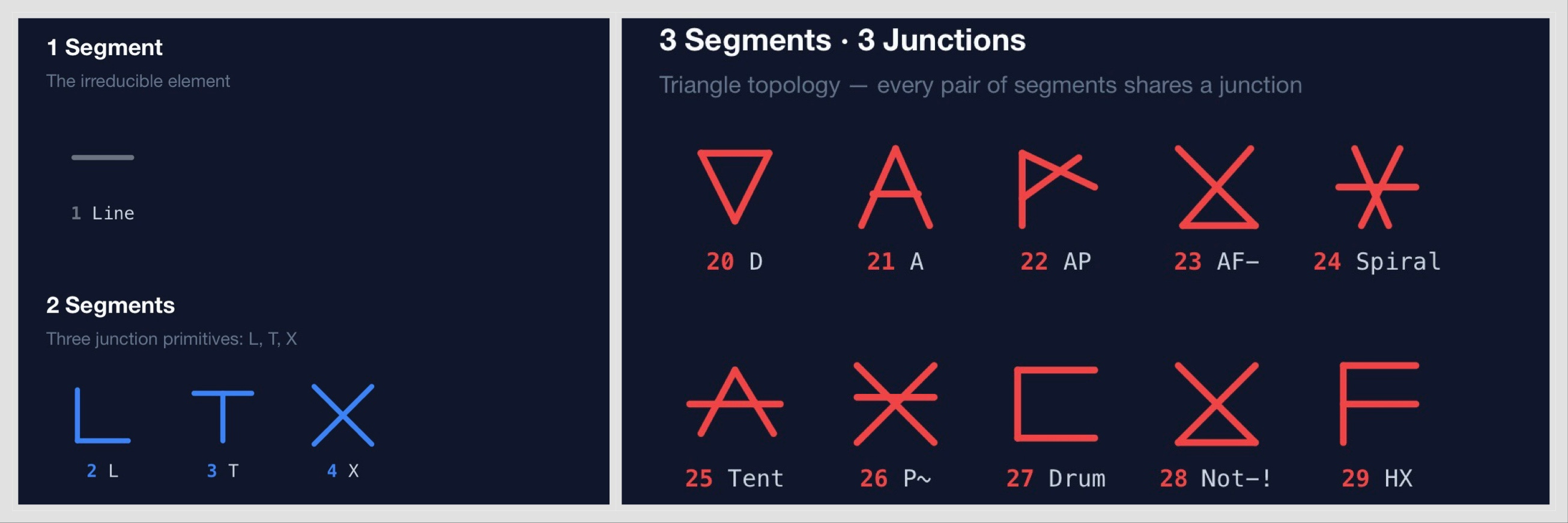
The answer is 36.
The structure is hierarchical.
One configuration from a single stroke — the element.
Three configurations from two strokes — L, T, and X themselves, the generators.
Thirty-two configurations from three strokes — every possible way three lines can meet, cross, or corner under the intersection constraint. The junction types are the operators.
The 32 are what the operators produce. The catalog of 36 includes both.
There is no 37th. The constraints exhaust the space.
Changizi then measured how often each of these 36 configurations appears in approximately 100 writing systems across all of recorded history. Latin, Arabic, Chinese, Tamil, Cherokee, Phoenician, Korean, Cyrillic, dozens more. He measured them in nonlinguistic symbols — music notation, traffic signs. He measured them in photographs of natural visual scenes: savannas, villages, cityscapes, forests.
The frequency distributions match. The shapes common in writing systems are common in natural scenes. The shapes rare in one are rare in the other. The correlation: R = 0.88, p < .000001.
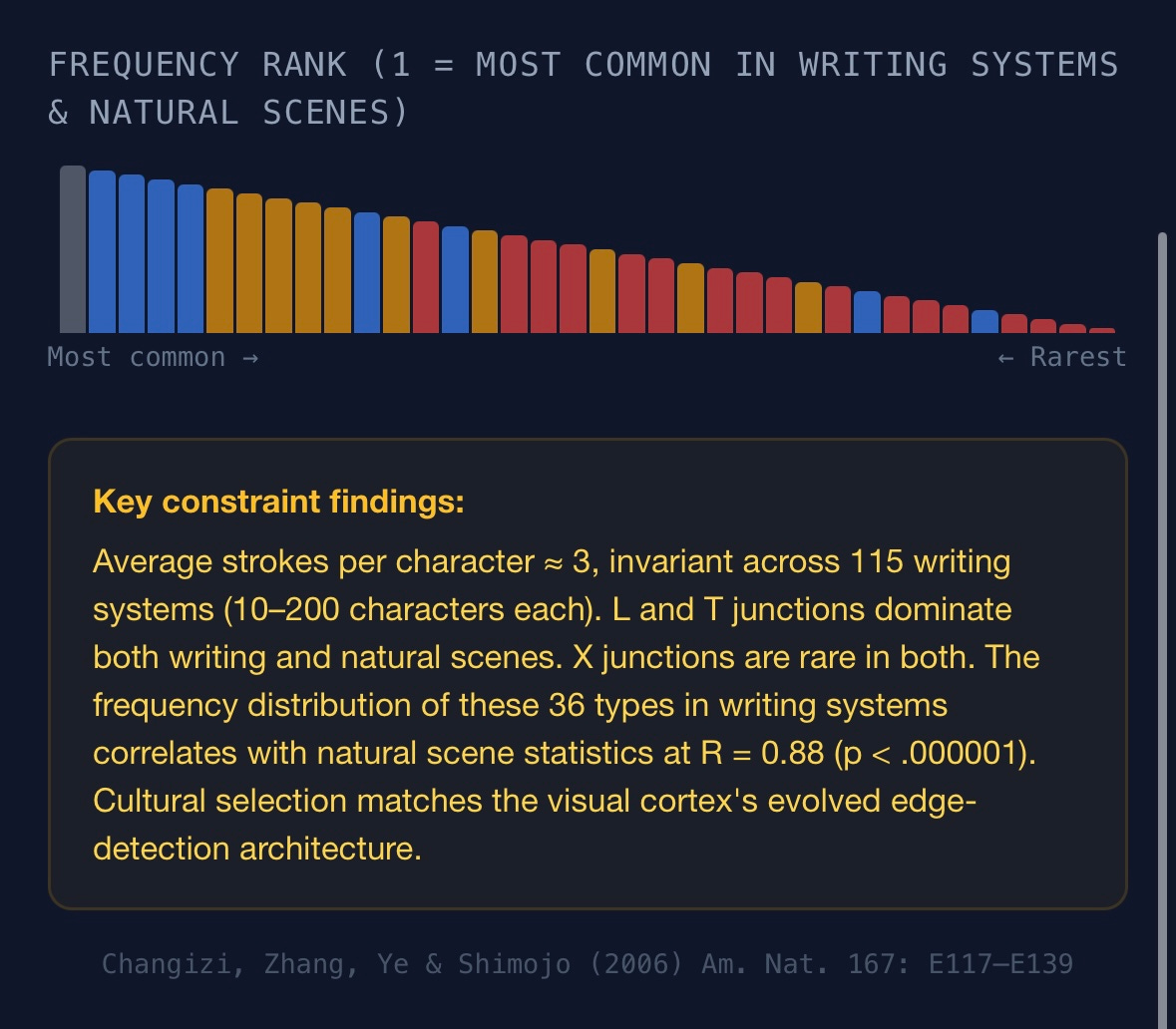
Letters are shaped the way they are because they fit the hardware. Writing systems across every culture and every century converged on the same forms — because those forms are what V1 was already wired to detect. The eye was there first.
One more number.
Across 115 nonlogographic writing systems, varying in size from 10 characters to 200, the average number of strokes per character is approximately three. This does not change as a function of system size. A 20-character alphabet and a 200-character syllabary use the same stroke count. Three is the processing ceiling.
Normally, V1’s output gets passed upward. Higher brain regions assemble the detected junctions into contours, surfaces, objects, scenes. You never see V1’s raw extraction. You see the coffee cup it was assembled into.
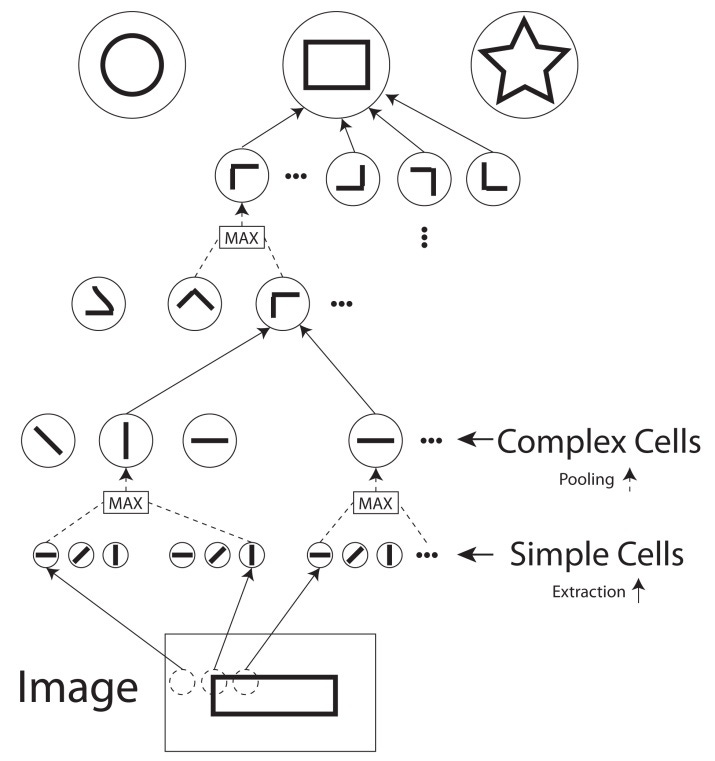
The REBUS model — Robin Carhart-Harris and Karl Friston — describes what psychedelics do to this hierarchy. They suppress the precision-weighting of high-level predictions. The top-down processing that normally interprets V1’s output (“that’s a wall,” “that’s a hand”) goes quiet. V1 keeps running. The assembly layer above it does not.
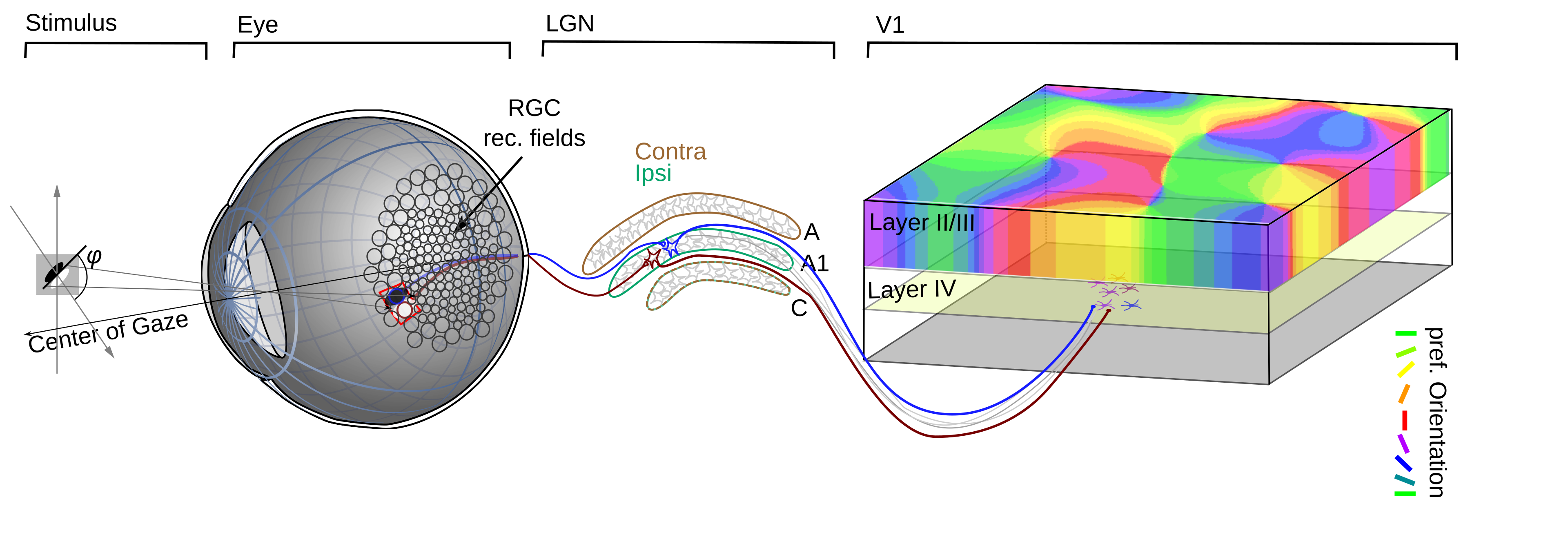
Imperial College London confirmed that DMT generates cortical traveling waves in visual areas nearly identical to those produced during actual visual perception. V1 is processing as though the input is real. It has nowhere to send the results.
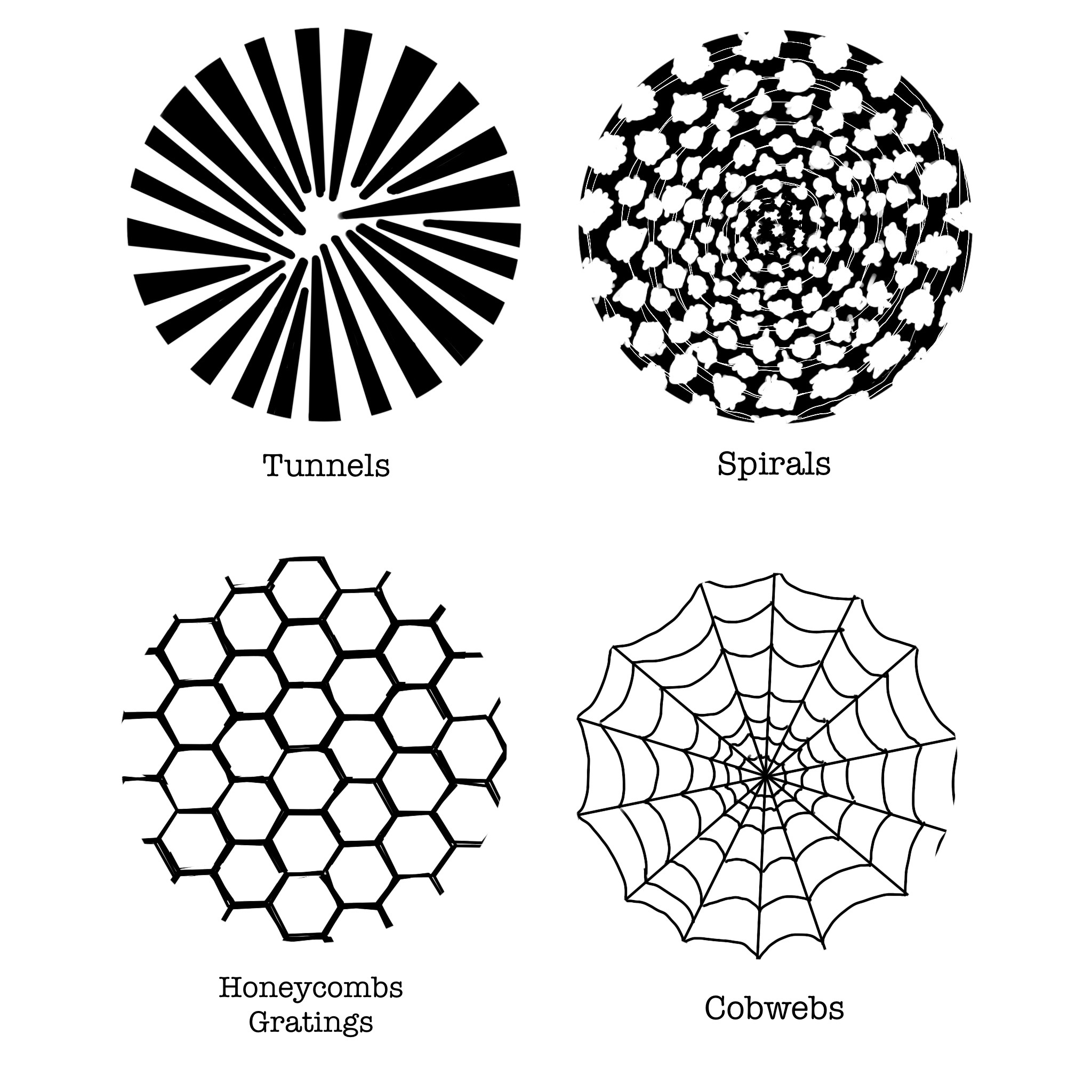
Close your eyes on DMT and V1 generates spontaneous activity — its own architecture firing without external input. The spirals, tunnels, and lattices that Klüver classified as “form constants.” That’s V1 seeing its own wiring pattern. The crystal resonating with itself.
The laser allows for something else to emerge.
A 650nm beam projected through a diffraction grating onto a textured surface creates an interference pattern with specific spatial frequencies, contrast gradients, and junction statistics determined by the surface microgeometry. This is real photonic input arriving at the retina. V1 does what it always does. It extracts junction configurations. L, T, X, and their three-segment combinations. But the assembly layer is suppressed. The configurations are extracted and have nowhere to go. Instead of being built into an object percept, they remain visible as raw features.

The subject sees V1’s output directly.
A microscope transforms light to reveal structure in a drop of water. This combination — diffracted laser plus pharmacologically stripped hierarchy — transforms perception to reveal structure in perception itself. The laser is the light source. The surface is the prism. The angular characters are the spectrum: the components of vision, separated and visible because the system that normally recombines them has been suspended.
Every reported feature follows from this mechanism.
The characters resemble katakana because katakana characters are angular, two- to three-stroke configurations — topological primitives. They are among the closest cultural reference points for what V1’s raw output looks like before hierarchical assembly. The subjects are describing the Changizi configurations as accurately as anyone could without a neuroscience vocabulary.
The code changes when the laser moves to a different surface because a different location produces a different interference pattern. Different spatial statistics in, different junction configurations out. The code on skin differs from the code on the wall because skin and drywall have different surface microgeometry.
And three people see the same symbols because three people have functionally identical V1 architecture. Same orientation columns, same hypercolumn periodicity — approximately 1.4 mm — same lateral connectivity. Feed the same optical stimulus into three copies of the same processing architecture under the same hierarchical suppression and you get the same output.
It feels like reading because it has the statistical structure of reading. These are the features that make literacy possible. Every alphabet in human history was built from these forms because they are what V1 extracts. The body recognizes them as structured and information-bearing because in every prior encounter across every culture and every century, they have been.
If this mechanism is correct, it generates specific predictions — and at least one has already been partially confirmed outside the psychedelic context entirely.
Charles Bonnet syndrome. People with deteriorating vision experience vivid visual hallucinations. Letter and digit forms appear in roughly a quarter of cases. No substance. No laser. A visual cortex deprived of input, generating the forms its architecture is built to produce. Different cause. Same output. Same hardware.
The remaining predictions: the reported characters, collected as drawings from subjects, should be classifiable within the Changizi catalog — clustering in the high-frequency types and absent from the rarest. The characters should shift systematically with surface texture: surfaces rich in occluding geometry producing more T-dominant forms, surfaces rich in corners shifting the distribution toward L-dominant forms. Inter-observer agreement should correlate with V1 architecture similarity, measurable via fMRI retinotopic mapping. The phenomenon should fail to appear with substances that alter vision through pathways other than hierarchical suppression. And the average stroke count of reported characters should cluster around three.
The code is real. It is the finite set of topological primitives that the primary visual cortex extracts from every visual scene — 36 configurations generated by three junction types operating on three or fewer line segments. These primitives appear in every writing system in human history because cultural evolution selected for shapes that fit the brain’s processing architecture. DMT suppresses the assembly. The laser provides real input. What remains visible is V1’s raw extraction — the alphabet underneath all seeing.
It looks like language because every language was built from it.
Beyond Seeing
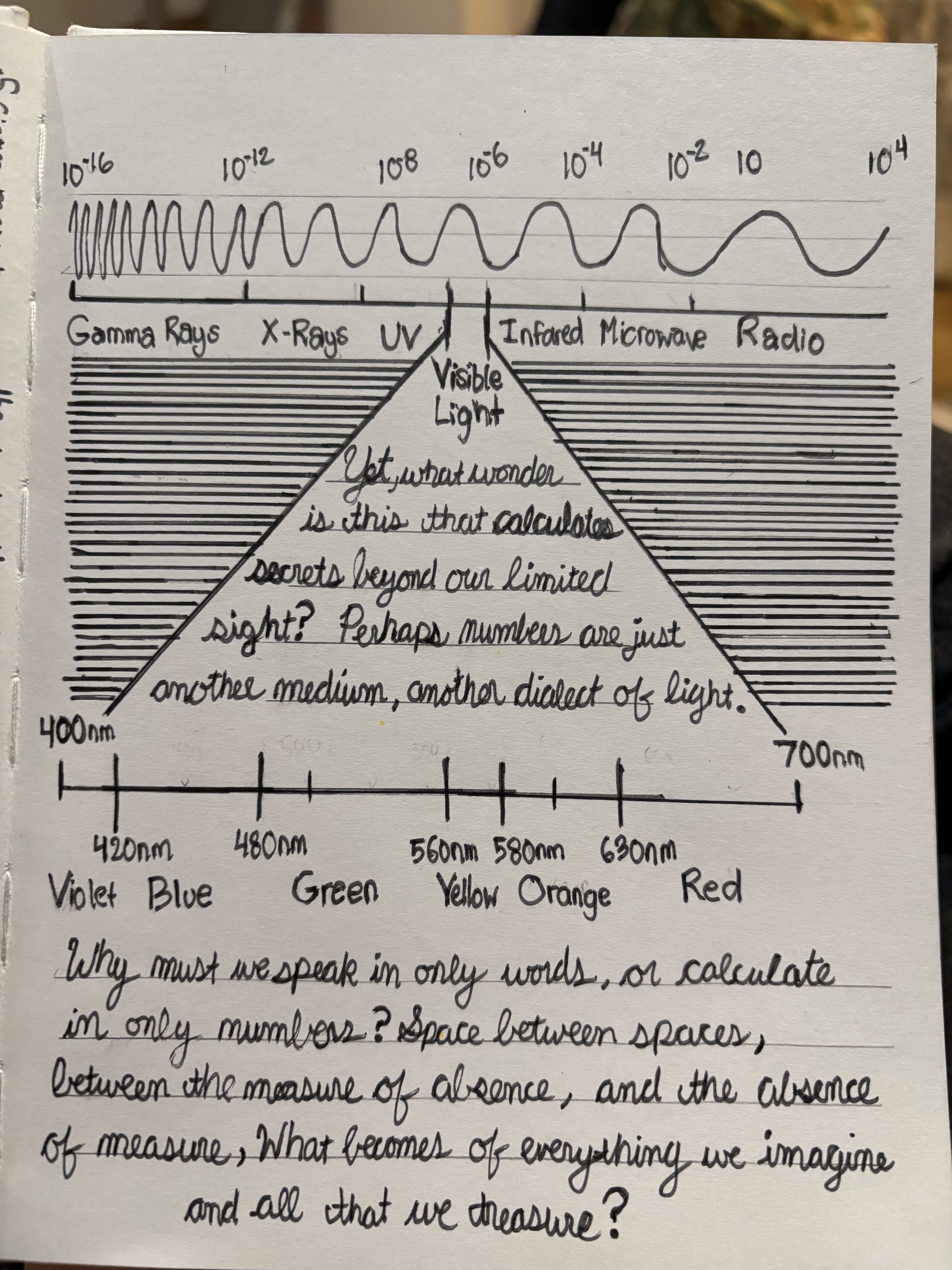
I’ve been writing about what happens when language operates beyond the body’s capacity to check it — extraction, institutional capture, the distance between what words assert and what flesh can verify. This is the other end of that same gradient. At the level of edges and junctions and light on a textured surface, the body’s measurement is the whole story. No interpretation required. No linguistic frame to distort it.
There is a place where seeing is still direct. Where the cortex meets the world at the resolution of edges, and what it finds there is a finite alphabet older than any culture that ever wrote with it. Pharmacology revealed it in minutes. Cultural evolution found it over millennia. The body knew it all along.
References
Changizi, Zhang, Ye & Shimojo (2006). The Structures of Letters and Symbols throughout Human History Are Selected to Match Those Found in Objects in Natural Scenes. The American Naturalist 167: E117–E139.
Bressloff, Cowan, Golubitsky, Thomas & Wiener (2001). Geometric Visual Hallucinations, Euclidean Symmetry and the Functional Architecture of Striate Cortex. Phil. Trans. R. Soc. Lond. B 356: 299–330.
Carhart-Harris & Friston (2019). REBUS and the Anarchic Brain. Pharmacological Reviews 71(3): 316–344.
Goler (2025). Detailing a Pilot Study: The “Code of Reality” Protocol. IPI Letters 3(1): N1–N5.
Timmermann et al. (2023). Human brain effects of DMT assessed via EEG-fMRI. PNAS 120(13): e2218949120.
I have a related experience in relation with low blood sugar states as type 1 diabetic.
Seeing hieroglyphs or Hebrew looking symbols when reading letters. It translates to other objects by their forms turning into having different outlines that are very geometric. It makes me loose sense of the objects and words. It's very trippy and almost fun.
It goes away once blood sugar is stabilized.
I found several accounts of this.
It's basically certain brain parts not having enough fuel or working properly while others do.
I still have a feeling that this also reveals a part of reality we usually don't see cause our brain translates it to what we usually experience
I bet DMT opens something to the brain and consciousness we usually don't experience as the brain gates it.
Now.. in a way would we want to live in the "laser world" probably not but it's still fascinating to understand what it means beyond just altered brain states.
My experience is there is a psilocybin zone that lets you experience the pseudo-language without lasers. A blackout mask quiets the visual system and lets what the visual cortex is doing to come to the surface. There’s a low level color coding the visual cortex uses - white, green, blue and red, yellow it navigates by.