
The Found Stick
On the difference between studying a thing and standing next to it.

It’s simpler than I wanted it to be.
There’s a particular mix of relief and shame in finding that the thing you’ve measured, modeled, and built toward for months—or years?—can be said in a sentence. Both come from one source: you chase something that feels like a discovery, and your five-year-old reaches the answer that mattered more in minutes.

I spend a year on the marshmallow. Its history, its chemistry, how it holds its shape in heat, whether it keeps its loft in a vacuum or deflates into something you can barely see. I learn the etymology. I chart the thermodynamics. At the end I engineer the perfect roast: a Bunsen burner for a flame I can govern to the degree, a robotic arm to hold the mallow at the exact angle, the turn timed to the millisecond. Every ingredient is off the shelf and held fixed — Honey Maid, Hershey’s, Jet-Puffed — so the roast is the only thing I let move. The lone variable. The research pays off. The s’more is spectacular. Flawless.
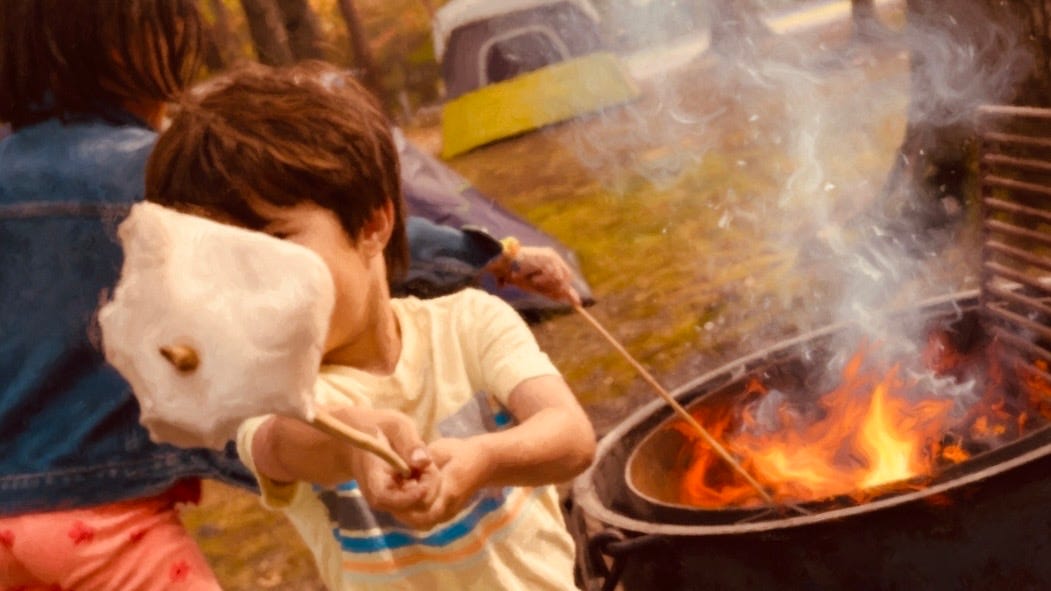
The next week I feel like a Neanderthal at the fire with my kids, holding a found stick over a roar I can’t control. Same graham. Same chocolate. Same marshmallow. My son and daughter roast unevenly — the mallow catches and blackens before I can blow it out. By the laboratory’s measure, a failure. They’re looking at me, expectant — they cooked this one for me. I bite in. The skin cracks into a charred shell; the inside runs hot and creamy, smoke on it, a taste of real burning wood — the one flavor my perfect setup could never make. Uneven, sugar caught in every state of heat at once, and better for it. The two of them watch my mouth. The flawless one I could repeat forever. This one I couldn’t run twice — and it won.
This is the forgotten place, the one that eludes us on these platforms. The forgetting is manufactured. What’s forgotten is the body of the thing, the texture that won’t fit a screen — the limit of what language can carry. Our stories and statistics are secondhand by origin, mistaken for firsthand. This is what language has done to us, and recently, this is what I have done with language.
Seeking begins where trust in what you feel stops; you chase the ideal for months and walk past the plain reality in front of you the whole time. The months earned me the tongue that can taste the difference — the thing beats the account of the thing, every time you can reach it.
The trouble is how rarely we can reach it now.
Shut a person in a room alone and written language swells to fill the space — the only anchor left when isolation thins the line between you and your own experience. Soon all you hear is your own thoughts and their echo, and the words stop pointing at the world and start standing in for it. The words on the screen become the other; the images become the window. And language holds its grip on us in inverse measure to how well we can check it — weakest where you can see and touch and weigh, strongest where you can’t. The screen sets verification at the maximum distance. Everything arrives as words and pictures, lit on glass, carried by parties with reasons of their own.
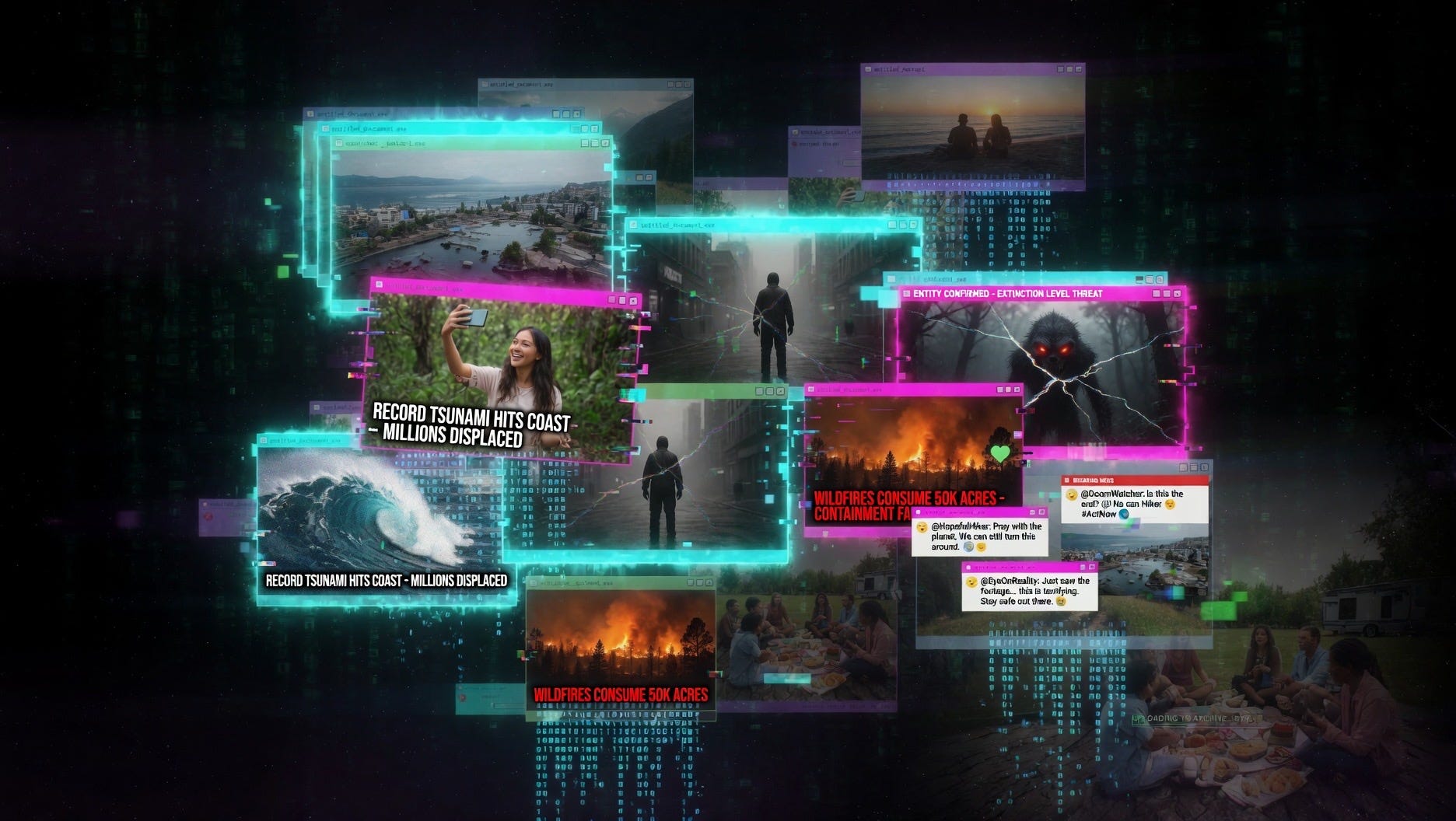
It does more than mislead. It pulls your own body in to vouch for it. The feed shows you a thing, your jaw tightens, you feel something hit in your guts, and the real feeling in you gets filed as proof the thing was real, fake news or not. The loop closes inside you. You become the witness for a fire you never stood next to.
So I log on, having published my formula, and I find performance everywhere. Or sincerity — I couldn’t tell you which, since all of it reaches me the same way, through the same lit glass. People name politicians they’ve never met, and never hope to, as God or as Satan outright. They howl about wars a continent off and walk past what’s in front of them — the fight at the kitchen table, the price of the food in the cart, the family taken from the house down the street.They treat the game of telephone as a first source, and the chain runs longer than any of us are shown, because no one discloses its length.
The fix is dull and old. A short chain. A thing close enough to reach. A stick you found, a fire you’re standing next to, the kids who were holding the answer the whole time. If you’re lucky, you come back and see what you sought was already here — and your absence hasn’t lost you their presence.
Inspirited Insight — notes on language, the body, and the difference between the thing and the account of it. Subscribe for the next one.