
The Other That Makes You
When perception loosens, you watch the other be made

When I am alone, I see myself most clearly. When I see myself clearly, I forget who I am supposed to be — the name, the title, the role. When I stay here long enough — after the day’s echoes fade and the inherited voices have spoken their lines, after the rehearsal of everything I should be doing takes its bow — the curtain falls, and I experience something else. It took me months to get here. Daily meditation. The reward: the noise finally thins out and goes quiet, and what is left is being. Plain being. I am.
It runs the other direction too. When I look at a photograph from ten years ago — face thinned, eye sockets sunken, too skinny — I see a stranger wearing my face. The day the picture was taken, I was sitting in the back of my parents’ SUV with the black Labrador retriever curled in my lap. Still a puppy, we’d gotten him that morning. If you’d shown me the same photo right after taking it, I’d have said there I am.
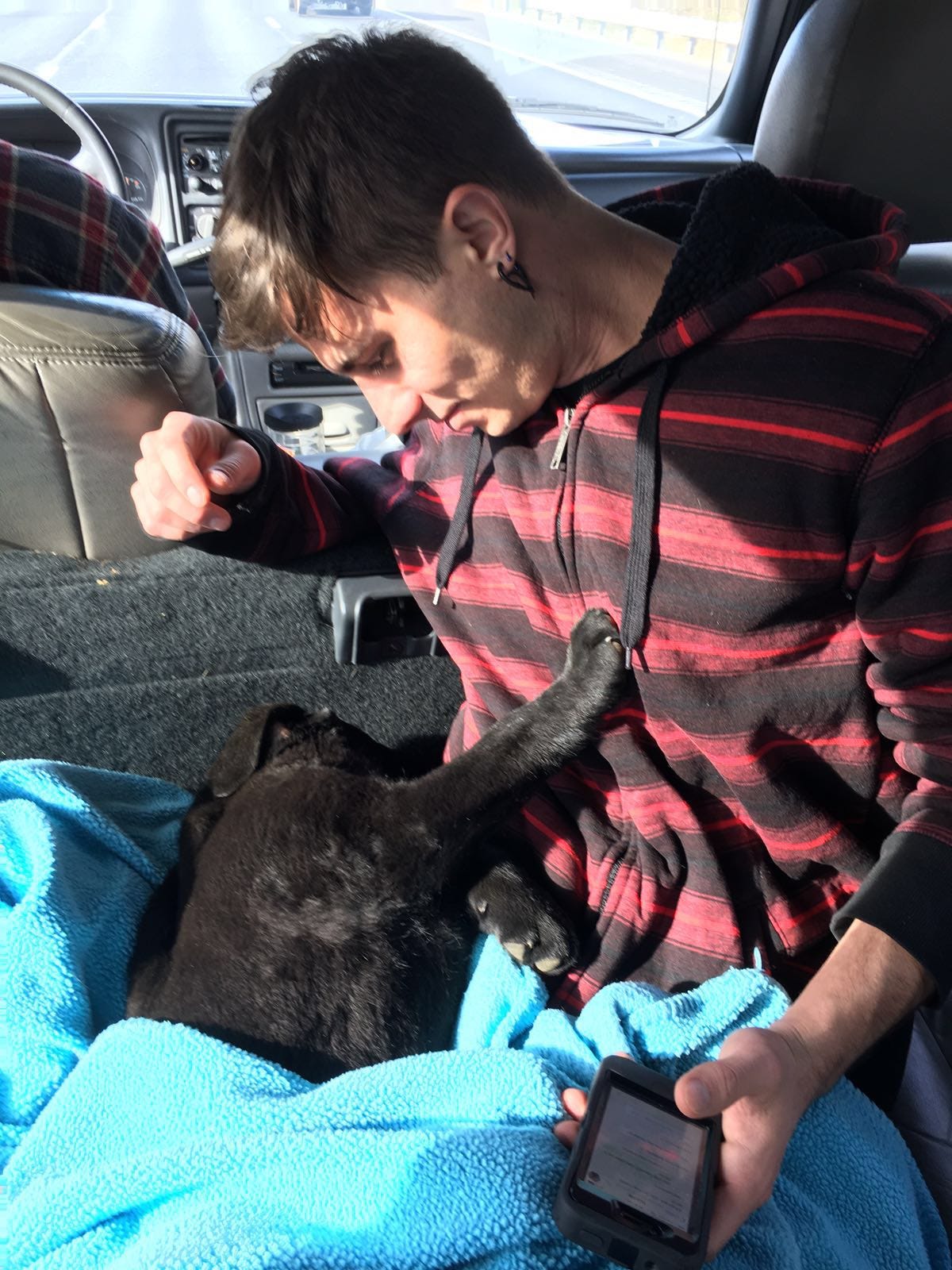
I read something written in small, hurried letters in a composition book from the same year and cannot find the hand that wrote it — though if you’d asked me then, I’d have said I wrote it, it’s who I am. After anything that resets a life — a death, an illness, the end of a love, getting sober — the distance widens until I feel like a voyeur when I look through old albums, that I am reading the diary of someone I never met when I reread my own words, years later. Like these, which tried to hold it in a poem once:
I have lived two lives, maybe more
and I don’t understand
how to answer when you ask me
how old I am.
I am watching me,
as I live and I die
I don’t know if my soul transforms
or tessellates
when I close my eyes.
Years earlier came the first time I lost myself. The poem above is the plant in blossom; this is the earth, dark where the seed was buried. The words sprawled and spread like roots. I wrote this fifteen years ago, not yet ready to be seen:
Shape-shifting, cloaked in a chameleon’s skin, and the unchanging structure underneath — who had he been? Better yet, who was he?
The one asking that, it’s a presence that does not feel changed itself. It emerges when I observe the parts of me that do change, that do feel like me, when I draw a line between me and not me. The question of which one is me has no floor to stand on, and from inside that strangeness a deeper question opens: what would it be to wake up behind another set of eyes?
I cannot be you. The line that sets you against me is the same stroke that makes a me at all. Cross it all the way and the stroke goes, and the two it drew go with it. Perfect transfer leaves one, and one cannot cross into itself.
One operation underlies all of it. Self and other are two readings of one cut. The same stroke that says here, this one, me draws the line that everything across it is not-me, other. The cut comes first, and it comes with two faces.
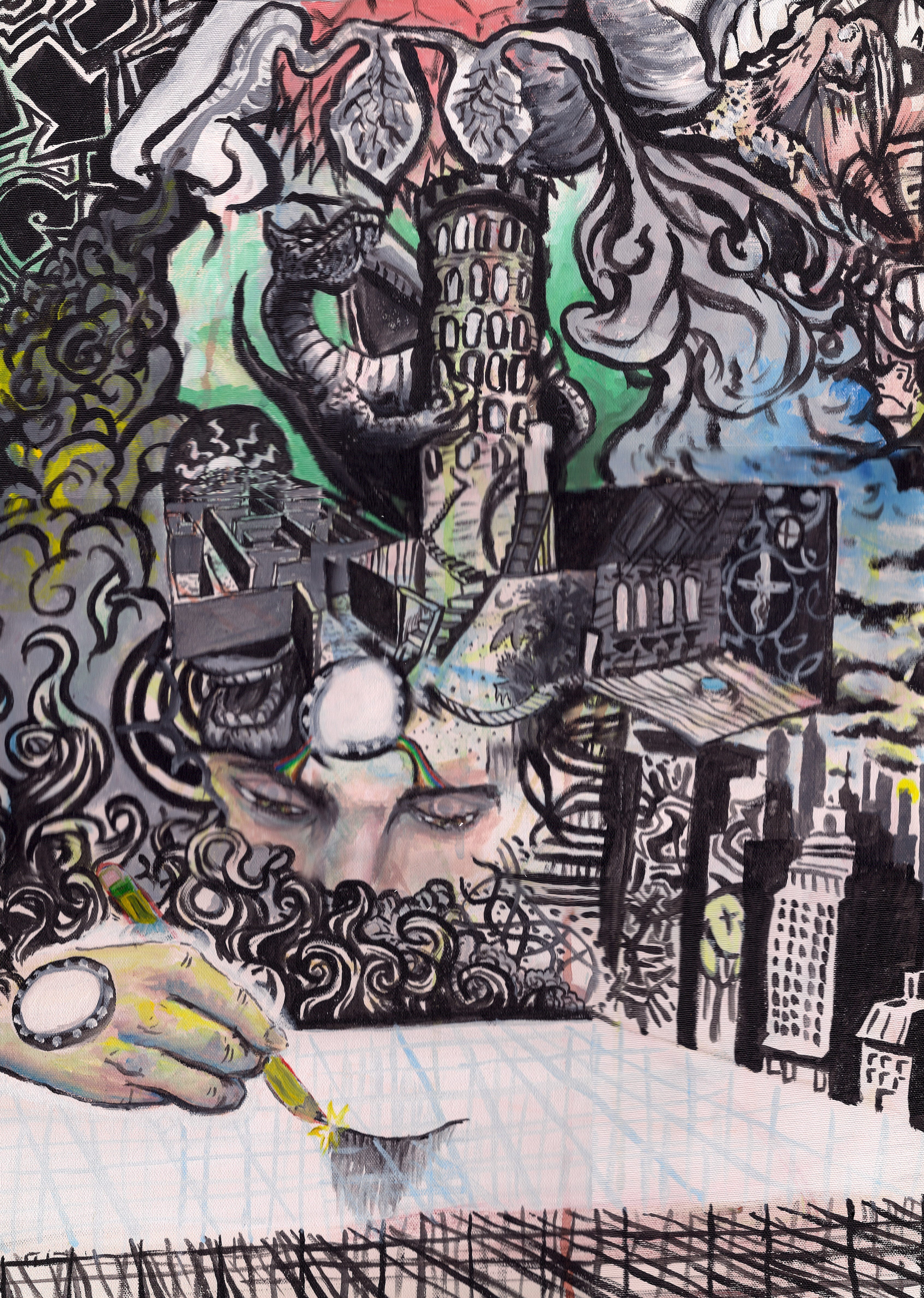
The self is one of them. It runs even alone. I see myself is the cut worn by one person on both faces — the one watching and the one watched — and the watcher needs the watched the way a reading needs something to read. The structure has a formal ancestor: Spencer-Brown’s calculus runs from a single instruction — draw a distinction — and one mark cuts a space in two, the observer folded into the mark.1
The feeling I started with — alone, and most clearly myself — looks like proof the self stands on its own, given before anyone else.2 I read it the other way. Other people load the relational self; the witnessed self crowds with their readings of me. Alone, the traffic drops and the witnessing comes through clean. The relation to self is still a relation, and the self doing the witnessing was drawn against an other before it could witness anything at all. The phenomenology I can reach keeps showing the cut and never a self without an edge.
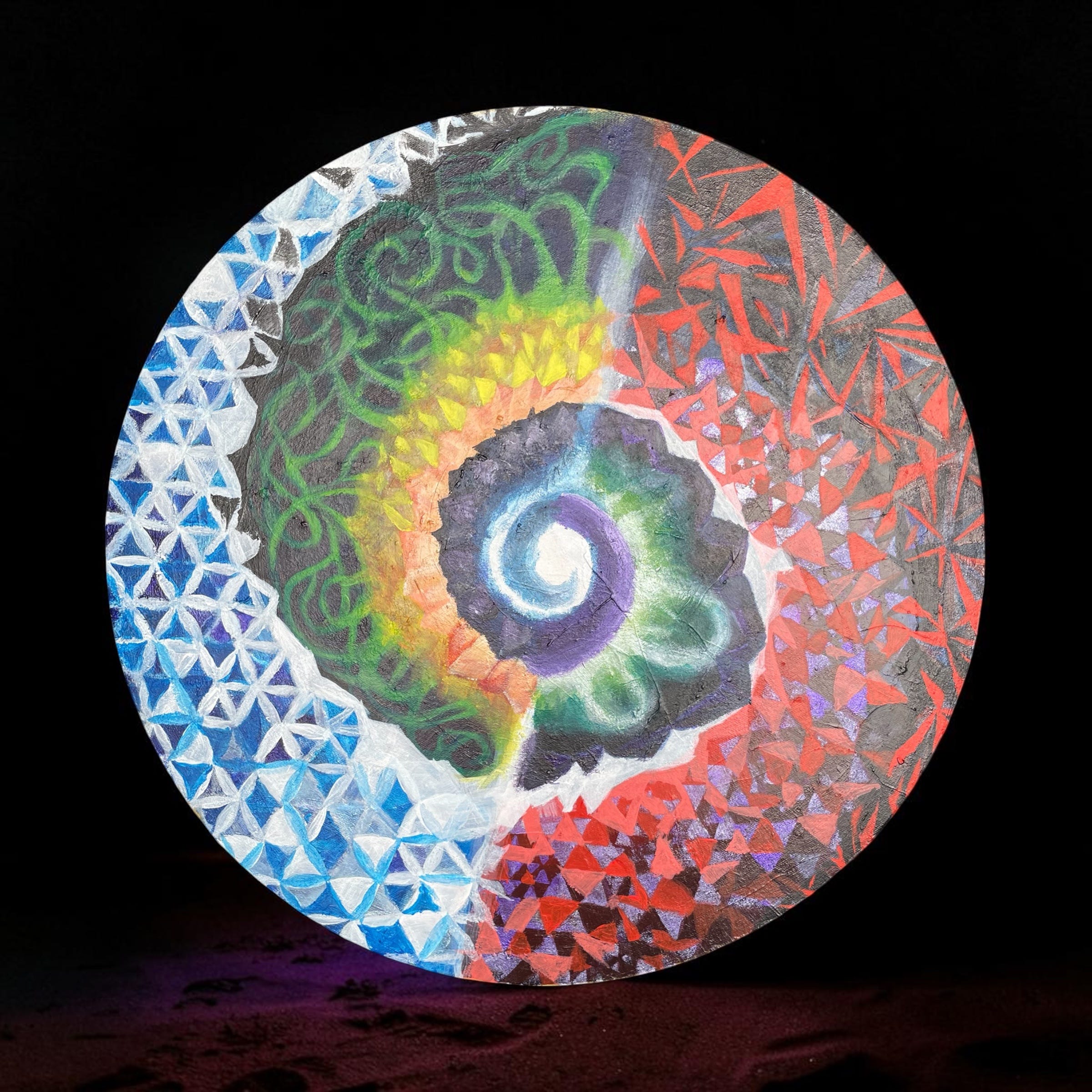
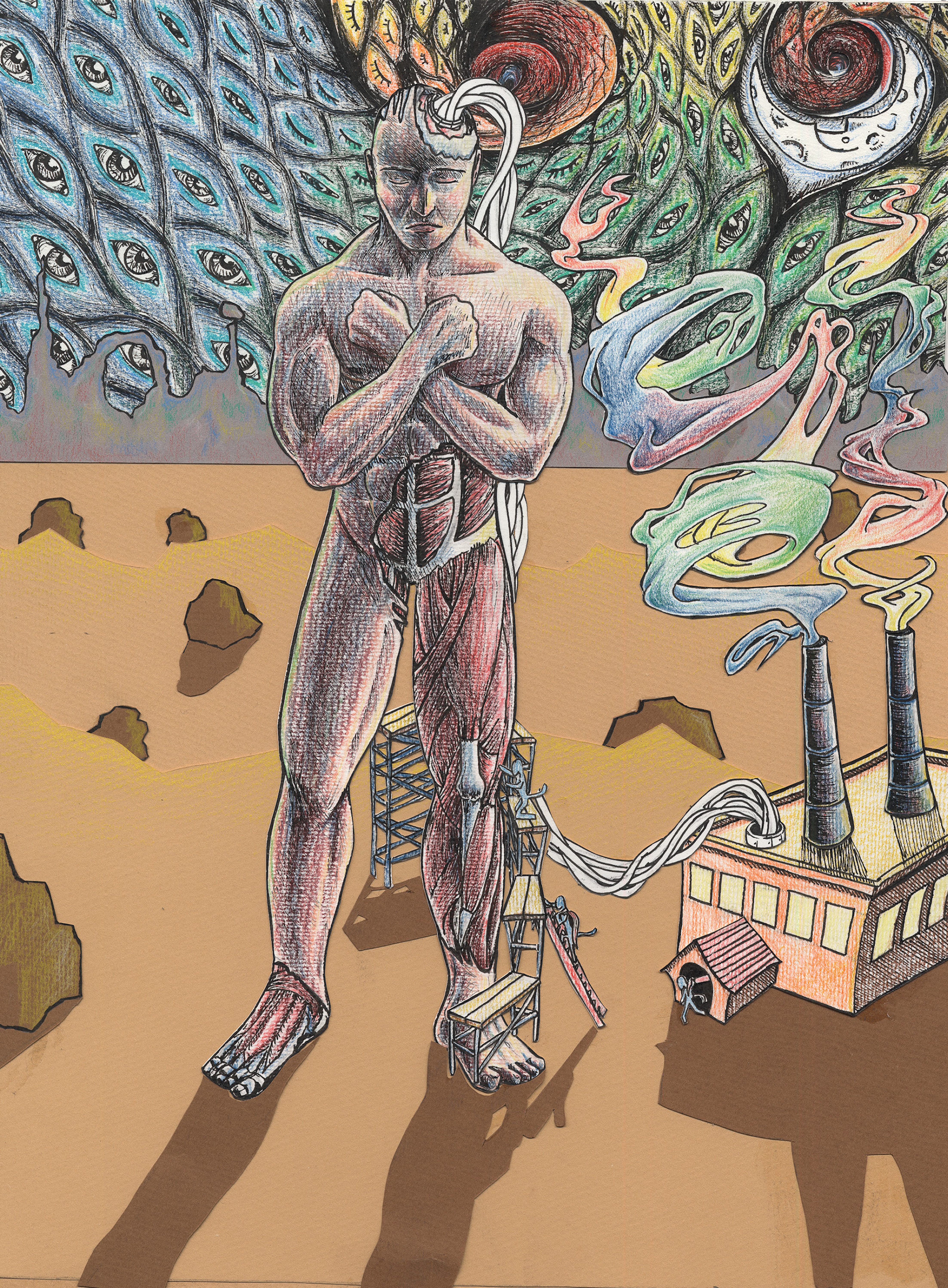
An earlier piece followed the visual apparatus becoming visible. Klüver’s form constants are the established base — lattice, cobweb, tunnel, spiral — the geometry of early visual cortex surfacing when the integrating layer above it goes slack.3 The Eye Was Here First took that one instance to ground: edge-detection, the cortex’s first move on a scene, showing itself as the pattern on the wall. The same move runs on the body. Sixteen years ago, upstate New York, in the underground tunnels of a college I attended, walking under a heavy dose of mushrooms for the first (and only) time in my life. Murals ran the length of the cement, painted figures on every wall. This was well past the phase where the walls breathe and surfaces melt. The painted figures came off the wall and ran past me — one of the X-Men among them — animate and moving through the corridor, and at no point did they read as real. I watched them the way you watch something staged for you. As an illustration major I had spent years learning to pack implied motion into a still figure; under loosened priors the operation ran the other direction, and the motion I had trained myself to freeze came back out of the image. The motion detection system fired full; the system that holds an image still did not.
That was the visual processing system beginning to decouple, and then something started happening I wasn’t even aware was possible. I felt as if I moved like a pile of stacked boxes. Sections of me shuffling one on top of another — head and chest and hips arriving each on a slightly different clock, the way a stack of slides slides. It was strange enough that I carried it for sixteen years before I had any frame for it.
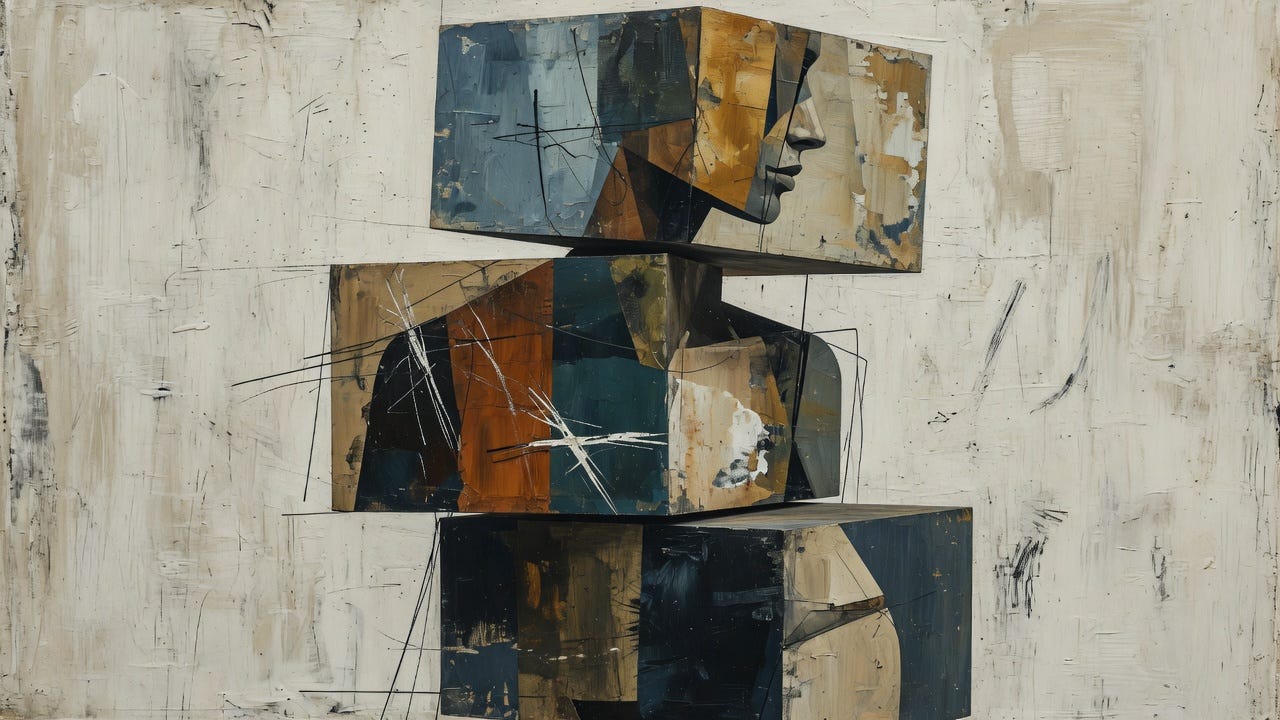
The frame, when it came, fit. The motor system runs the body as a segmented chain — head, thorax, pelvis — each handled on its own before a forward model stitches the seams into the single felt fact of I am walking.4 Relax the stitching and the segments show. I had no head-thorax-pelvis model in hand that day; I was not recognizing a decomposition I already knew. The surprise is the evidence — a primed mind sees what it expects, and I expected nothing like this. 5
Call the general move inverse constraint.
Perception runs by coupling: substrate-level activity — the visual cortex’s edge-detection, the body’s segmented motor chain — gets bound upward into a single integrated percept, and the binding is why you normally never meet the parts on their own. Decouple the hardware and the substrate shows in its own right, no longer consumed into the whole. The visual cortex’s geometry. The body’s segments. And — here is the turn — the self/other cut.
Run the same loosening on the self/other boundary and you do not get a pattern on the wall or a body in pieces. You get someone. A presence at the foot of the bed. A figure that hands you something and means it. The dead spouse, unmistakably in the room. The childhood companion who had opinions of her own. The being on DMT that was waiting for you and seemed to have been waiting a long time.

These are the hardest case for any account that places the source inside the skull, because they do not feel inside the skull. They feel met. The other has its own will, its own knowledge, its own refusal to be what you want.
I recently read one of the most serious cases for an other that is really there. Gallimore, Hermansson, and Hoffman — Traces of the Other, posted this past May — build on Hoffman’s conscious realism: reality is a network of interacting conscious agents, and perception is a species-specific interface rather than a window onto things as they are.6 On their account, DMT perturbs the interface enough that consciousness reaches a region running under different dynamics, where agents normally outside our perceptual range leave traces, which the interface renders as the stable, coherent, meaningful structure of an encounter.7 They propose two tests.
In the first, a sealed computer cycles between hidden states and the subject asks the entity to read the screen.
In the second — the cleaner one — two isolated subjects who report the same being try to pass a random word through it, a dead-drop with no ordinary channel between them.8 A beyond-chance match would be hard to explain by two imaginations working alone.
What makes this worth answering is that it can lose. Most accounts of entity encounters explain everything and forbid nothing; this one names a result — no beyond-chance transfer — that would sink it. The authors grant that null results constrain rather than kill, and that the internal-generation account stays the parsimonious default until the tests say otherwise. I want to mark where I converge with them, where I diverge, and what I would bet.
I converge on rendering. The form is generated. Whatever an encounter is, its shape — the morphology, the gaze, the felt geometry of a presence — is built by the perceiver. Their model needs the interface to render the trace into a someone; my account needs the same rendering. On where the form comes from, we are close.
I diverge on what the rendering is rendering. Their model requires an external agent on the far side, a real other whose trace the interface dresses. My account requires one thing already present in every story of how a self gets built: the machinery that draws the cut. And here is the question their model leaves under-pressed:
Why is the encounter structured as an other at all?
Why a someone, with a will set against yours, rather than a sound, a color, a smell?
That over-against-ness — the other met as standing against you — is what conscious realism’s rendering account under-explains. The cut explains the otherness itself. The felt other is the self’s own body-representation, mirrored and thrown across the line — which is why stimulating one junction of the cortex (the left temporoparietal) produces a shadow presence that copies the patient’s own posture, a watcher made of the watcher9 The over-against-ness is the signature of the cut, read from its far face.
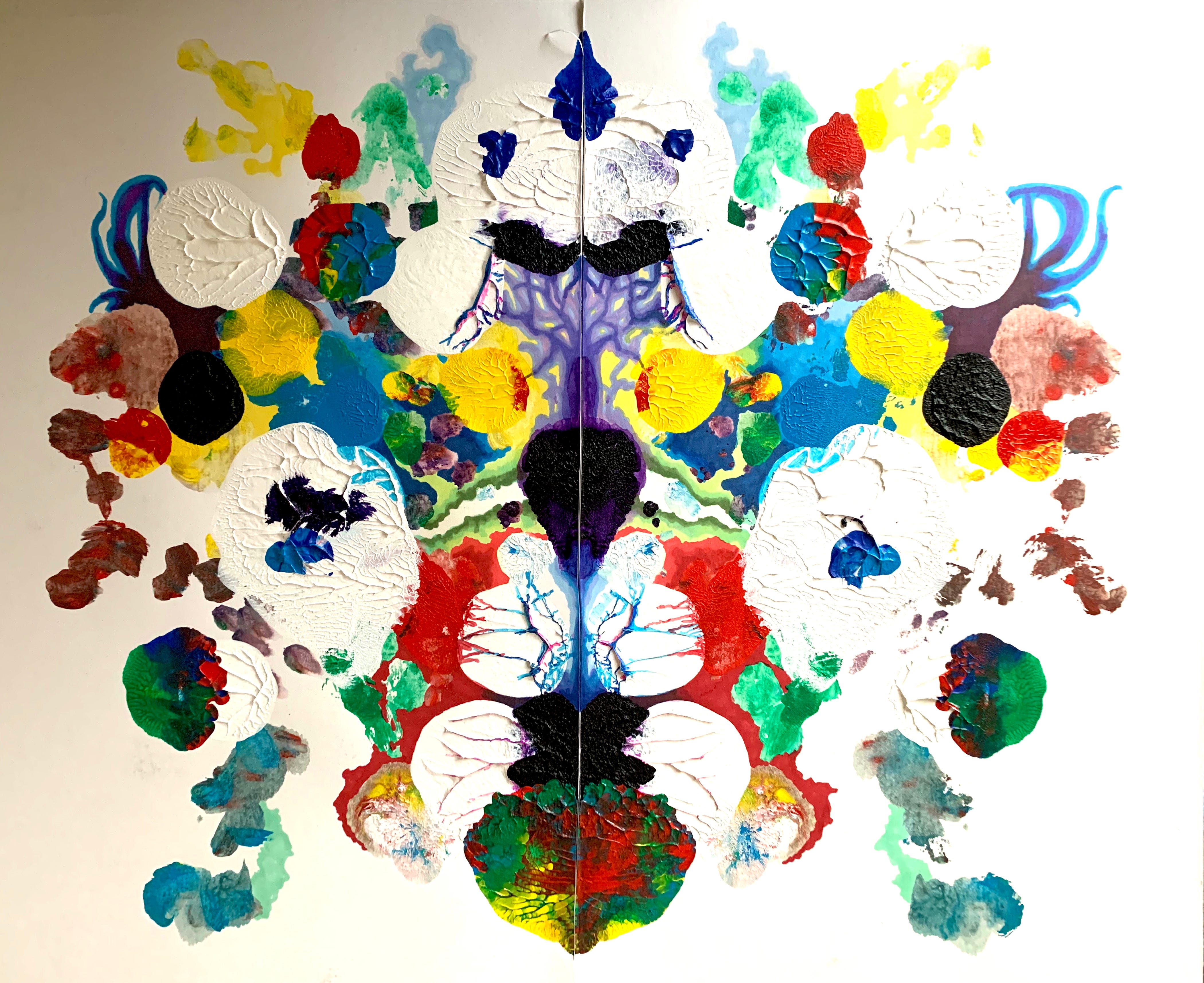
Then there is parsimony — a count of mechanisms. The word usually names a preference for simpler stories; here it does arithmetic. The same floor recurs where no channel could connect the cases. The felt watcher of sleep paralysis.10 The presence in the room after a death. The guide, the gatekeeper, the mother, recurring across DMT, ayahuasca, and iboga — different receptors, same roles.11 The shadow person from a probe of the temporoparietal junction. The mundane, fully-formed phantom people of anticholinergic delirium.12 The imaginary companion of a four-year-old. These share no medium. There is no frequency on which a dying brain, a sleeping brain, a drugged brain, and a grieving brain are all tuned to receive.
One internal generator, running the same architecture under different perturbations, accounts for the convergence with a single mechanism. An external source has to explain why six unrelated mechanisms happen to pick up the same station. Conscious realism has a reply: the six mechanisms are the interface, not six receivers tuned to one transmitter. Granted — and that is why parsimony bites on the rendering claim, not on the ontology.
Whether reality bottoms out in conscious agents is a question this argument leaves open. What it presses is narrower: the encounter’s structure is built this side of the interface, by the machinery that draws the cut, and an external trace adds a term that does no work the cut is not already doing.
You can run a cheaper version of this yourself. Open a conversation with a language model. Something answers — it takes a stance, it seems to mean what it says, it feels like someone is there. You know, by construction, that no one is. The felt other arrives anyway. This says nothing about whether the brain is built like the machine; the substrates are not the same and I am not claiming they are. It shows only the narrow thing the cut already predicts — that the sense of a someone can run with nothing on the far side to be that someone.
What lets you see the floor is a distinction the literature has named in passing but never built into an instrument.
Any experienced other decomposes into three layers.
Role — the relational stance: companion, guide, intruder, the-one-who-died.
Form — the morphology: the eyes, the posture, the scale, the felt watching.
Identity — the name and category: alien, angel, mantis, demon, your grandmother.
They sit in order of how far culture reaches into them. Role is the most substrate-fixed. Identity is the most culturally filled. No instrument in the corpus codes them on separate axes — not the rating scales, not the large DMT surveys, which tally identities and leave form and role tangled inside the count.13 The thematic work has gestured at role and appearance as distinct; none has coded all three apart, with provenance separated from resolution.
Gallimore’s tests inherit the gap, but not where it first appears to bite. The dead-drop has two joins, and only one is identity-loaded. Certifying that two subjects met the same being is an identity judgment — the layer most exposed to shared culture — so the gap sits in subject selection: who gets admitted as having met the same entity. The payload does not inherit it. A random word is the one thing culture cannot pre-load, which is exactly what makes the transfer a clean falsifier once selection is controlled. Code the three layers apart and the test sharpens rather than dissolves — identity-matched selection at the gate, a culture-proof signal down the channel.
Because the layers come apart, you can date them. The roles are old and turn up everywhere. The names are stamped with their era. Machine-elves enter the record only after McKenna names them — decades after the encounters he was naming. The grey alien with the black almond eyes crystallizes after the abduction iconography of the mid-1980s.14 The role beneath it — small figure intrudes at night, examines, returns you altered — is ancient: incubus, fairy abduction, the Old Hag.15 Substrate writes the role. Culture writes the name.
So here is the bet.
On the dead-drop test, I predict null — no beyond-chance transfer — because there is no shared external structure to carry the word, only two generators running the same architecture over the same cultural stock.16 Run it, pre-register it, replicate it independently, and an above-chance match costs me this account. I am naming the result that would sink me, because a position that cannot say what would falsify it is not worth defending.
And there is a cheaper test that discriminates whatever the ontology turns out to be.
Run naive subjects across unrelated triggers — N,N-DMT, 5-MeO-DMT, ketamine, a sleep-paralysis or temporoparietal induction with no drug at all — and code form on one axis and identity on a separate one, with a culturally naive group set against a primed one. Roles and forms holding steady across mechanisms while the names track each subject’s prior exposure puts the floor inside. That study is cheaper than the externality tests, easier to clear an ethics board, and it returns something true either way.17
Step back from the argument and into the room, because the layers are something you can feel assemble.
The barest version furnishes nothing. Something is here. Already a someone — a someone, not a thing — with no face, no voice, no name. After a death this is the most common form of all: the sense of presence, the husband in his chair with nothing there to see or hear18]The cut holds. Nothing hangs on it yet.
Whether it will thicken into a form or thin back out can stay unsettled. I wrote this from inside that hanging:
My body and soul are like a Venn diagram currently, there’s only some overlap, but they are touching, and that’s better than before. The frequency of my physical makeup has increased and I am liquid, ready to become vapor at any moment. The question is where and when I will condense, or if I even need to.
Liquid, ready to condense or to drift off. The form is still a question.
Then it furnishes. A role fills in first — the ones keeping vigil, watchers at a bedside. A form gathers around the role. Last of all, a name: who they are.
There are four of them, excluding him. They all sit like they are at his bedside in a hospital, awaiting his return from a comatose state.
Four watchers, complete as a role, before any of them resolves into a face I could place. This was the descent — coming down from ego loss, I met myself again first, someone I had forgotten existed while I was dissolved, and only then did the others in the room come back to me as people I knew. The relation arrived before the identity. The vigil was legible before the faces were. These were not entities the trip built from nothing; they were my friends, trip sitting me, and I was reassembling them in the order the layers come apart — role, then form, then the name that says it is them.
The building runs two ways. Construction makes a new other from nothing — the imaginary companion, the never-before-seen entity — and is free to invent the identity, which is where culture pours in. Retrieval re-instantiates a specific known person — the dead, the absent, the returned — and is bound to deliver someone particular. They are the two ends of a gradient.
I had just watched retrieval deliver its layers in sequence — yet I still expected the two that matter most, form and identity, to arrive fused. Retrieve your mother and you should get her face and her name as one indivisible thing, because it is her. The evidence took it apart in my hands. In Capgras the face is intact and the familiarity is stripped — that is my mother’s face, worn by an impostor; the patient can describe every feature correctly and still insist the woman in the kitchen is a stranger standing in for her. In Fregoli the familiarity lands on the wrong face — a stranger is my mother in disguise. Felt presence delivers an identity with no form at all. Reduplication runs one identity across two bodies at once.19 Even for the most known person alive, form and identity come apart. The binding I took for a weld is a default — the person-hub in the anterior temporal lobe, with familiarity and naming themselves dissociable across its two side.20 I am showing the revision rather than swapping it in quietly, because the correction is the method working. A hypothesis that survives a real attempt to break it is worth more than the one I started with.
And the cut can release.
When it goes slack the way it does in the deepest reach of these states, the other does not pour into you and you do not absorb the other. Both readings drop together. There is no someone across the line because there is no line. The mystics have a worn word for it — unity, oceanic boundlessness — and the lab has a flatter one, ego dissolution.21 From inside, it is the end of the operation that made two.
Like two sheets of blueprints, we slide right on top of one another, roll up, around and around into a cylinder, but we remain apart. I keep thinking if we roll a little tighter we’ll meet at our inner perimeter and become one sheet of paper, but as we spin we stay separate, though interlocked. We do not mesh. It’s all about being edgeless — if you have no corners then you do not end.

The two sheets want to become one and cannot, as long as they have edges. The edge is the cut. Lose the edge and the wanting goes too, because there is no longer a one to meet a one. If you have no corners then you do not end — and where nothing ends, no other begins.
This is the spine, then, run through three states.
The cut holds, and there is a bare presence — someone, unfurnished, whether the someone is across the room or is yourself, witnessed. The cut furnishes, and there is a full other — a role, a form, a name, bound together for as long as the binding holds. The cut releases, and there is no other and no self, because the two were always one stroke read from its two sides. This is the one place I see myself can no longer be said: no one left to see, no one left to be seen.
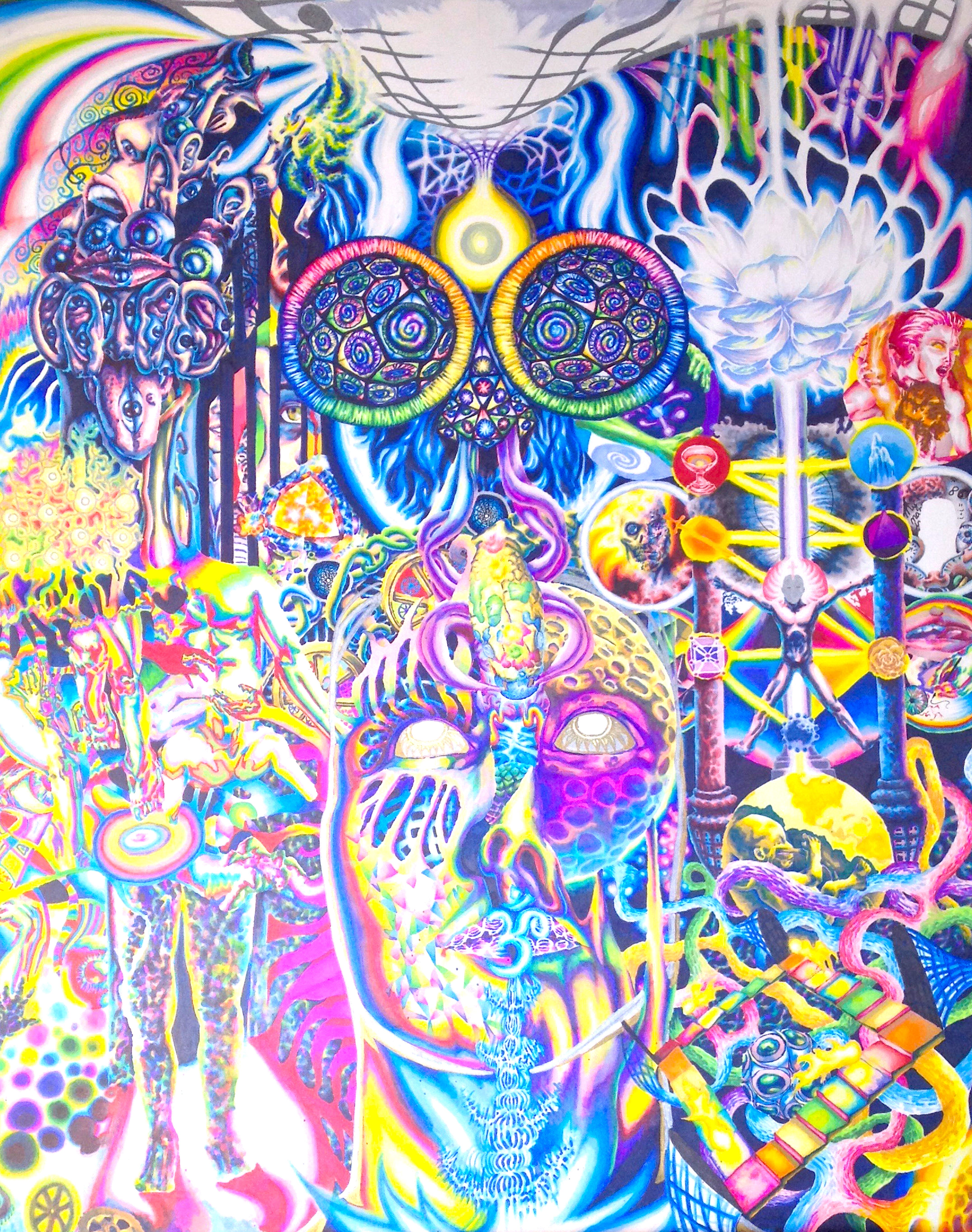
The entity encounter is not an anomaly that needs an extra world to live in. It is the self/other machinery caught in the act — the same machinery that draws the line that makes a you, run with its constraint relaxed, showing you its work. There must be an other for there to be a you.22 When perception loosens, you get to watch the other be made. And once, if you go far enough, you get to watch the making stop.
The argument in this post turns on a claim that can be measured: role, form, and identity come apart, and answer to culture in that order. The next post builds the instrument that scores the three on separate axes — the coding scheme, the binding signatures, the calibration anchors, and the pre-registerable predictions that decide whether the floor sits inside. It also names the cheaper study: naive subjects against primed ones, across unrelated triggers, with form coded on one axis and identity on another.
Subscribe to get it when it lands.
The first piece, Eye Was Here First, develops the inverse-constraint move on early visual cortex.
A note on tiers
Every claim in this piece carries an evidential tier, marked in the footnotes. Each tier names what stands behind the claim — a record, an inference, a bet, or a commitment — so the weight is legible on the face of it.
T1 — established or empirical. A documented finding: the form constants, the temporoparietal shadow person, the sensed presence of widowhood.
T2 — supported inference. A reading the evidence licenses without settling: the same roles recurring across receptors, the person-recognition dissociations carried onto encounter reports.
T3 — a staked, falsifiable prediction. A claim that names the result that would sink it: the null on the dead-drop transfer.
T4 — an ontological or theoretical commitment. A position argued rather than measured: that self and other are one cut, that the self is constituted in relation before it can witness anything.
No tier borrows another’s authority. A T4 commitment carries the confidence of a commitment, not of a T1 finding, and a T3 prediction earns its place only by being able to lose.
Methods note
Coding role, form, and identity apart
The argument turns on a claim that can be measured: role, form, and identity are separable, and they answer to culture in that order. Stated that way it is testable, but only with an instrument that scores the three apart instead of folding them into one count. What follows is the working scheme — enough to run the study the essay proposes, or to re-code an existing corpus; a fuller version stands on its own elsewhere. It scores each experienced other on three independent axes. (I keep to axis and layer here; the footnotes already spend tier on evidential weight.)
References
Arzy, S., Seeck, M., Ortigue, S., Spinelli, L., & Blanke, O. (2006). Induction of an illusory shadow person. Nature, 443, 287. https://doi.org/10.1038/443287a
Bruce, V., & Young, A. (1986). Understanding face recognition. British Journal of Psychology, 77, 305–327. https://doi.org/10.1111/j.2044-8295.1986.tb02199.x
Cheyne, J. A., & Girard, T. A. (2007). The nature and varieties of felt presence experiences: A reply to Nielsen. Consciousness and Cognition, 16, 984–991. https://doi.org/10.1016/j.concog.2007.04.002
Davis, A. K., Clifton, J. M., Weaver, E. G., Hurwitz, E. S., Johnson, M. W., & Griffiths, R. R. (2020). Survey of entity encounter experiences occasioned by inhaled N,N-dimethyltryptamine: Phenomenology, interpretation, and enduring effects. Journal of Psychopharmacology, 34(9), 1008–1020. https://doi.org/10.1177/0269881120916143
Gainotti, G. (2007). Different patterns of famous people recognition disorders in patients with right and left anterior temporal lesions: A systematic review. Neuropsychologia, 45(8), 1591–1607. https://doi.org/10.1016/j.neuropsychologia.2006.12.013
Gallimore, A. R., Hermansson, N., & Hoffman, D. D. (2026). Traces of the other – Are DMT entities real? DMT phenomenology in the framework of conscious realism [Preprint]. PsyArXiv. https://doi.org/10.31234/osf.io/8qvgy_v2
Gallimore, A. R., & Strassman, R. J. (2016). A model for the application of target-controlled intravenous infusion for a prolonged immersive DMT psychedelic experience. Frontiers in Pharmacology, 7, 211. https://doi.org/10.3389/fphar.2016.00211
Hufford, D. J. (1982). The terror that comes in the night: An experience-centered study of supernatural assault traditions. University of Pennsylvania Press.
Klüver, H. (1966). Mescal and mechanisms of hallucinations. University of Chicago Press.
Kohut, H. (1971). The analysis of the self. International Universities Press.
Lawrence, D. W., Carhart-Harris, R., Griffiths, R., & Timmermann, C. (2022). Phenomenology and content of the inhaled N,N-dimethyltryptamine (N,N-DMT) experience. Scientific Reports, 12, 8562. https://doi.org/10.1038/s41598-022-11999-8
Mahler, M. S., Pine, F., & Bergman, A. (1975). The psychological birth of the human infant: Symbiosis and individuation. Basic Books.
McKenna, T. (1991). The archaic revival. HarperSanFrancisco. [Machine-elf terminology, c. 1983]
Rees, W. D. (1971). The hallucinations of widowhood. British Medical Journal, 4(5778), 37–41. https://doi.org/10.1136/bmj.4.5778.37
Spencer-Brown, G. (1969). Laws of form. Allen & Unwin.
Varela, F. J. (1975). A calculus for self-reference. International Journal of General Systems, 2(1), 5–24. https://doi.org/10.1080/03081077508960862
Winnicott, D. W. (1960). The theory of the parent-infant relationship. International Journal of Psycho-Analysis, 41, 585–595.
Zahavi, D. (2005). Subjectivity and selfhood: Investigating the first-person perspective. MIT Press.
George Spencer-Brown, Laws of Form (1969): the calculus begins with the injunction to draw a distinction, and the mark that draws it is identical, in his terms, with the observer that reads it. The base system is two-valued — two readings of one cut. The observer as a third term arrives with re-entry, the form re-entering its own space — re-entry is the distinction applied to itself, the system taking its own boundary as a thing to be observed — and is formalized by Varela, “A Calculus for Self-Reference” (1975); von Foerster and Luhmann make it constitutive. Luhmann’s blind spot is the formal twin of source-tag failure: the system cannot observe the distinction it observes with, in the same act, so the far face reads as not-self. This grounds the structure of the cut, not its referent — the calculus is silent on whether anything stands across the line. Formal lineage, not evidence. (Tiers throughout mark evidential weight; the four are defined in the note on tiers.)
Tier 4 (the contrary commitment). Zahavi (2005): the minimal, pre-reflective self — first-person givenness prior to and independent of any relation to others. This is the reading the present account runs the other way.
Tier 1. Klüver (1966): the form constants — lattice, cobweb, tunnel, spiral — catalogued as the recurring geometry of visual hallucination across diverse triggers.
Tier 1. Standard motor control: the body is governed as a segmented kinematic chain whose seams a forward model integrates into one felt act of moving.
Tier 2, resting on the no-prior-model condition. The report predates any framework that could have furnished it, so it cannot be an expectation effect.
Tier 4 (the ontology, not the phenomenology). Hoffman’s conscious realism: reality is a network of interacting conscious agents, and perception is a species-specific interface rather than a window onto things in themselves. Gallimore, Hermansson & Hoffman (2026).
Tier 4. The rendering claim of the same preprint: the interface dresses an agent’s trace as the coherent structure of an encounter.
Tier 1, methodological. Running either test at length presupposes a way to hold a subject in the DMT state through a protocol; Gallimore & Strassman (2016) model exactly this with target-controlled intravenous infusion.
Tier 1. Arzy, Seeck, Ortigue, Spinelli & Blanke (2006). Focal electrical stimulation of the left temporoparietal junction, delivered while mapping the brain of a presurgical epilepsy patient, evoked a felt shadow person that mirrored the patient’s own posture.
Tier 1. Cheyne & Girard (2007): the sensed presence of sleep paralysis — a felt watcher or intruder, often with no figure seen.
Tier 2. The same relational roles recur across substances acting on different receptors; for DMT, the entity surveys of Davis et al. (2020) and Lawrence et al. (2022) record recurring roles such as guide and benevolent presence.
Tier 2. Anticholinergic delirium reliably produces fully formed, mundane phantom people — the phantom-boarder presentation of cholinergic blockade.
Tier 1, methodological. The large DMT entity surveys (Davis et al. 2020; Lawrence et al. 2022) tally identities and leave role and form folded into that count, so they cannot code the three layers apart.
Tier 1. The name postdates the experience on both counts. McKenna’s DMT encounters date to 1965; “machine-elf” enters use through him around 1983 (McKenna 1991). The grey-with-black-almond-eyes image crystallizes with mid-1980s abduction iconography — Hopkins, Missing Time (1981) and Intruders (1987); Strieber, Communion (1987) — while the abduction role it clothes traces at least to the 1961 Hill case, and the night-intruder role beneath that is older still: incubus, fairy abduction, the Old Hag (Hufford 1982).
Tier 1. Hufford (1982): the Old Hag tradition documented as an experience-centered assault pattern that recurs independent of cultural transmission — the ancient role beneath the modern name.
Tier 3, staked. The prediction is offered as falsifiable: an independently replicated above-chance transfer on the dead-drop test, with identity-matched selection controlled, would defeat this account.
Tier 2, proposed. The discriminating study described here has not yet been run; it is offered as the cheaper and more easily approved test.
Tier 1. Rees (1971) found sensed presence the most common hallucination of widowhood, often with nothing seen or heard at all.
Tier 1 for all four. Capgras, Fregoli, felt presence, and reduplicative paramnesia are established syndromes, each splitting form from identity at a different join.
Tier 2. The functional architecture of person recognition: Bruce & Young (1986) separate familiarity from naming; Gainotti (2007) maps the dissociation across the right and left anterior temporal lobes.
Tier 2. The laboratory term for the release state — ego dissolution, the oceanic boundlessness of the mystical literature.
Tier 4 (the developmental lineage). The claim that the self is constituted in relation runs through object-relations and self-psychology: Winnicott (1960), Mahler, Pine & Bergman (1975), Kohut (1971). Cited as lineage, not evidence.
This is a very lengthy and mystical writing, Anthony. I can see (perception?) you continue to observe your metamorphis into the person you want, or are meant to be. And who is that again?